
 EnglishCurrent
 德语
德语 阿拉伯语
阿拉伯语 法语
法语 印尼语
印尼语 日语
日语 韩语
韩语 马来语
马来语 葡萄牙语
葡萄牙语 俄语
俄语 西班牙语
西班牙语 泰语
泰语 土耳其语
土耳其语 越南语
越南语

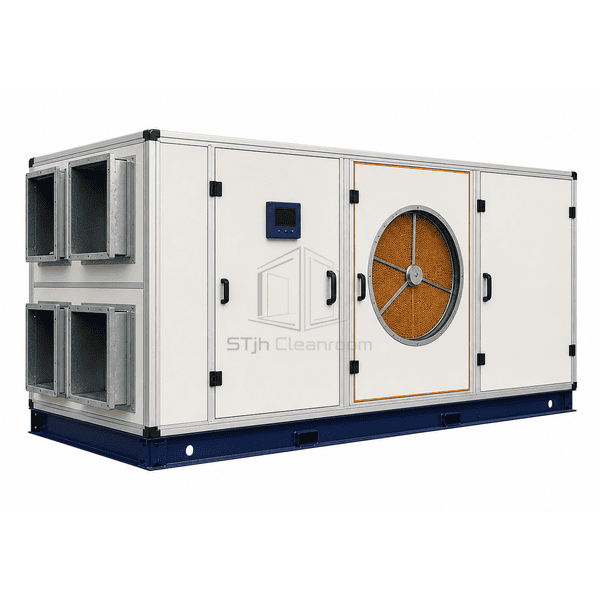
Cleanroom HVAC and Air Handling Equipment
Dry Room Air Handling Unit
An integrated desiccant air handler that combines deep moisture removal, regeneration, cooling and recirculation for ultra-dry production rooms.
- Desiccant Rotor Drying
- Low Dew-Point Supply
- Separated Regeneration Air
- High Recirculation Efficiency
Product Introduction
The dry room air handling unit removes water vapor beyond the practical range of cooling coils by passing process air through a continuously regenerated desiccant rotor. A pre-cooling stage reduces incoming moisture load, the rotor performs deep drying, and post-cooling controls supply temperature. A separate heated regeneration airstream removes captured moisture from the rotor and discharges it outdoors. Recirculating most of the dry-room air limits the outdoor moisture load, while sealed casing and low-leakage dampers protect the achieved dew point.
Key Features
Separated process and regeneration air paths prevent wet regeneration exhaust from mixing with dry supply air.
Pre-cooling and sensible post-cooling reduce rotor load and set the final supply temperature.
High dry-air recirculation minimizes the quantity of humid outdoor air that requires deep treatment.
Customer Product Concerns
Ultra-low humidity is easily lost through casing leakage, door infiltration, wet regeneration carryover and moisture released by process materials.
A chilled-water coil cannot reach the required dry-room dew point.The desiccant rotor adsorbs remaining vapor after the air is precooled.
Regeneration exhaust leaks into the dry process airstream.Sealed rotor sectors, pressure control and purge arrangements limit cross-stream carryover.
Opening personnel or material doors causes slow humidity recovery.Sufficient recirculation airflow and controlled dry-air make-up remove the infiltration moisture load.
Reactivation heat dominates system energy use.Purge optimization, heat recovery and the appropriate steam, gas, electric or heat-pump source reduce regeneration demand.
Typical Applications
Lithium-ion battery dry roomsMoisture-sensitive pharmaceutical processingDry powder productionElectronics and component storageResearch-scale ultra-dry laboratories
Technical Parameters
Typical insulated casing construction for an integrated dry-room air handling unit is summarized below.
| Core Material | Closed-cell polyurethane insulation with silica-gel or molecular-sieve desiccant rotor media |
|---|---|
| Panel Thickness | 60–100 mm low-leakage insulated casing |
| Effective Width | 1200–4200 mm nominal equipment width |
| Maximum Length | Up to 15000 mm including process and regeneration treatment sections |
| Steel Facing Thickness | 0.8–1.2 mm coated or stainless casing skins |
| Core Density | 40–45 kg/m³ polyurethane panel insulation |
| Thermal Conductivity | 0.022–0.026 W/(m·K) for casing insulation |
| Surface Finish | Powder-coated exterior with sealed galvanized or stainless cleanable inner surfaces |
| Joint Type | Compression-gasketed low-leakage panels with sealed process and regeneration air paths |
| Customization | Available based on the intended application and operating environment. |
Available Options
Silica-gel or molecular-sieve rotorSteam, gas, electric or heat-pump regenerationDeep-drying single or multi-stage arrangementHeat recovery and purge-sector optimization
Planning a Dry Room Air Handling Unit specification?
Send us your dimensions, installation conditions, performance targets and required surface finish.