
 Inglês
 Alemão
 Língua árabe
 Francês
 Língua indonésia
 Japonês
 Coreano
 Língua malaia
 Portuguêsatual
 Língua russa
 Espanhol
 Tailandês
 Língua turca
 Vietnã

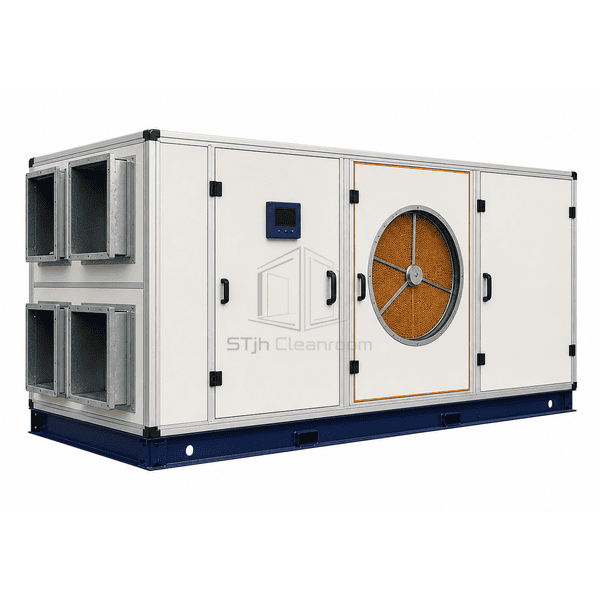
Equipamento de manuseio de ar e HVAC para sala limpa
Z Unidade de Manuseio de Ar de Sala Seca
An integrated desiccant air handler that combines deep moisture removal, regeneration, cooling and recirculation for ultra-dry production rooms.
- Desiccant Rotor Drying
- Low Dew-Point Supply
- Separated Regeneration Air
- High Recirculation Efficiency
Introdução do produto
The dry room air handling unit removes water vapor beyond the practical range of cooling coils by passing process air through a continuously regenerated desiccant rotor. A pre-cooling stage reduces incoming moisture load, the rotor performs deep drying, and post-cooling controls supply temperature. A separate heated regeneration airstream removes captured moisture from the rotor and discharges it outdoors. Recirculating most of the dry-room air limits the outdoor moisture load, while sealed casing and low-leakage dampers protect the achieved dew point.
Características-chave
Separated process and regeneration air paths prevent wet regeneration exhaust from mixing with dry supply air.
Pre-cooling and sensible post-cooling reduce rotor load and set the final supply temperature.
High dry-air recirculation minimizes the quantity of humid outdoor air that requires deep treatment.
Preocupações do produto do cliente
Ultra-low humidity is easily lost through casing leakage, door infiltration, wet regeneration carryover and moisture released by process materials.
A chilled-water coil cannot reach the required dry-room dew point.The desiccant rotor adsorbs remaining vapor after the air is precooled.
Regeneration exhaust leaks into the dry process airstream.Sealed rotor sectors, pressure control and purge arrangements limit cross-stream carryover.
Opening personnel or material doors causes slow humidity recovery.Sufficient recirculation airflow and controlled dry-air make-up remove the infiltration moisture load.
Reactivation heat dominates system energy use.Purge optimization, heat recovery and the appropriate steam, gas, electric or heat-pump source reduce regeneration demand.
Aplicações típicas
Lithium-ion battery dry roomsMoisture-sensitive pharmaceutical processingDry powder productionElectronics and component storageResearch-scale ultra-dry laboratories
Parâmetros técnicos
Typical insulated casing construction for an integrated dry-room air handling unit is summarized below.
| Material principal | Closed-cell polyurethane insulation with silica-gel or molecular-sieve desiccant rotor media |
|---|---|
| Painel de espessura | 60–100 mm low-leakage insulated casing |
| Largura efetiva | 1200–4200 mm nominal equipment width |
| Comprimento máximo | Up to 15000 mm including process and regeneration treatment sections |
| Aço enfrentando espessura | 0.8–1.2 mm coated or stainless casing skins |
| Densidade Core | 40–45 kg/m³ polyurethane panel insulation |
| Condutividade térmica | 0.022–0.026 W/(m·K) for casing insulation |
| Superfície acabado | Powder-coated exterior with sealed galvanized or stainless cleanable inner surfaces |
| Tipo conjunto | Compression-gasketed low-leakage panels with sealed process and regeneration air paths |
| Customização | Disponível com base na aplicação pretendida e no ambiente operacional. |
Opções disponíveis
Silica-gel or molecular-sieve rotorSteam, gas, electric or heat-pump regenerationDeep-drying single or multi-stage arrangementHeat recovery and purge-sector optimization
Planning a Dry Room Air Handling Unit specification?
Envie-nos as suas dimensões, condições de instalação, metas de desempenho e acabamento de superfície necessário.