
 EnglishCurrent
 德语
德语 阿拉伯语
阿拉伯语 法语
法语 印尼语
印尼语 日语
日语 韩语
韩语 马来语
马来语 葡萄牙语
葡萄牙语 俄语
俄语 西班牙语
西班牙语 泰语
泰语 土耳其语
土耳其语 越南语
越南语

Cleanroom Control and Environmental Monitoring Systems
VAV Control System
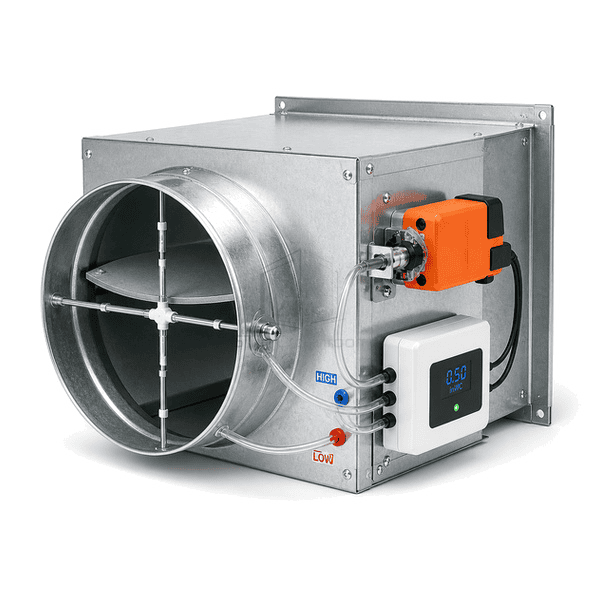
A pressure-independent variable air volume package that measures branch airflow and regulates a VAV damper across changing duct static pressure.
- Pressure-Independent Airflow
- Integrated Flow Measurement
- Minimum and Maximum Limits
- Networked Actuator Feedback
Product Introduction
The VAV control system integrates a differential pressure sensor, airflow calculation, controller and direct-coupled actuator on a factory-assembled terminal. It maintains the requested airflow even when upstream duct pressure varies within the operating range. Configurable minimum and maximum limits protect ventilation requirements and cap excessive branch flow. Supply, return and exhaust terminals can exchange airflow values with room pressure logic, while network communication exposes actual volume, setpoint, damper position and alarms to the supervisory system.
Key Features
Factory-arranged sensor tubing and actuator linkage reduce field assembly variables.
Minimum and maximum airflow limits keep operation within the terminal's useful control range.
Network feedback reports actual airflow, requested airflow and damper position separately.
Customer Product Concerns
A VAV branch must deliver stable air volume even as the main duct pressure changes with other terminal demands.
Airflow rises when other branches close and duct pressure increases.Pressure-independent measurement and damper control hold the requested branch volume.
A terminal cannot control accurately below its usable sensor range.Configured minimum airflow prevents operation in the unstable low-signal region.
Field-installed tubing is reversed or pinched during commissioning.Clearly identified high and low ports with short factory-routed tubing reduce connection errors.
The BMS sees actuator position but cannot verify delivered air volume.Independent airflow feedback confirms actual branch performance rather than inferred damper movement.
Typical Applications
Cleanroom supply-air terminalsLaboratory exhaust branchesAirlock transfer airflowVariable-occupancy controlled rooms
Technical Parameters
Typical materials and dimensions for a pressure-independent cleanroom VAV terminal are shown below.
| Core Material | Galvanized steel VAV casing with aluminum sensing cross, polymer controller and copper motor windings |
|---|---|
| Panel Thickness | 180-450 mm terminal depth |
| Effective Width | 150-800 mm nominal duct width or diameter |
| Maximum Length | Up to 1200 mm terminal assembly length |
| Steel Facing Thickness | 0.8-1.2 mm galvanized steel casing |
| Core Density | 7800-8050 kg/m³ for steel casing and damper components |
| Thermal Conductivity | 45-60 W/(m·K) for galvanized steel structural parts |
| Surface Finish | Clean zinc-coated steel casing with white controller and blue or orange actuator accent |
| Joint Type | Circular spigot or rectangular flange with integral averaging pickup and direct-coupled actuator |
| Customization | Available based on the intended application and operating environment. |
Available Options
Circular or rectangular terminalSupply, return or exhaust dutySpring-return actuatorBACnet MS/TP or Modbus RTU
Planning a VAV Control System specification?
Send us your dimensions, installation conditions, performance targets and required surface finish.