
 EnglishCurrent
 德语
德语 阿拉伯语
阿拉伯语 法语
法语 印尼语
印尼语 日语
日语 韩语
韩语 马来语
马来语 葡萄牙语
葡萄牙语 俄语
俄语 西班牙语
西班牙语 泰语
泰语 土耳其语
土耳其语 越南语
越南语

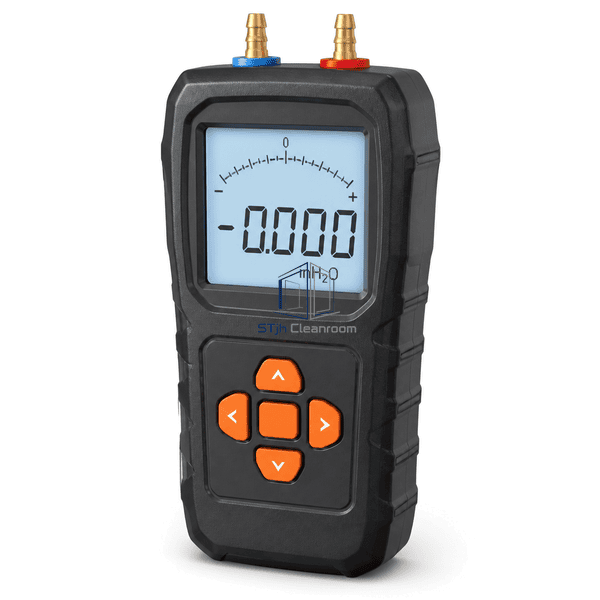
Cleanroom Testing and Validation Instruments
Micromanometer
A high-resolution dual-port micromanometer for cleanroom pressure-cascade checks, filter pressure-drop testing and Pitot-tube duct traverses.
- High-resolution low-pressure measurement.
- Dual ports for cleanroom cascade verification.
- Pitot velocity and volume-flow calculation.
Product Introduction
This portable micromanometer resolves small static and differential air pressures through two color-coded pressure ports. Automatic zeroing, selectable engineering units and damping help stabilize readings at airlocks and controlled rooms. With a Pitot tube and entered duct geometry, the same instrument can calculate velocity and air volume during ventilation commissioning.
Key Features
Dual ports support positive, negative and differential measurements.
Selectable damping steadies readings affected by door movement or turbulence.
Pitot input converts velocity pressure into duct air speed and flow.
Min, max and average capture supports systematic test-point review.
Rugged handheld enclosure suits qualification and maintenance routes.
Customer Product Concerns
Controlled environments depend on small pressure differences that must be measured without confusing transient fluctuations, tubing polarity or instrument drift.
Small room-pressure differentials can be obscured by sensor noise.A high-resolution low-pressure sensor with damping produces a stable displayed value.
Reversed tubing can make pressure direction difficult to interpret.Color-coded positive and negative ports make the connection polarity immediately visible.
Door movement creates short transients during cascade checks.Averaging and min/max capture distinguish the settled relationship from brief disturbances.
Duct velocity calculations add time and opportunities for arithmetic errors.Pitot mode and entered duct dimensions provide direct velocity and volume-flow results.
Typical Applications
Cleanroom pressure-cascade verificationAirlock and isolation-room testingHEPA filter pressure-drop measurementPitot-tube duct traversesHVAC commissioning and balancing
Technical Parameters
Typical portable micromanometer construction is summarized below; pressure range, damping, logging and probe accessories can be matched to the qualification method.
| Core Material | Piezoresistive pressure sensor, brass pressure ports and impact-resistant polymer enclosure |
|---|---|
| Panel Thickness | Typically 2.0-3.5 mm for the molded instrument housing |
| Effective Width | Approximately 75-100 mm across the handheld meter body |
| Maximum Length | Approximately 180-230 mm for the handheld instrument body |
| Steel Facing Thickness | Typically 0.5-1.0 mm for optional stainless Pitot and static-pressure probes |
| Core Density | Approximately 1050-1200 kg/m³ for the engineered polymer enclosure |
| Thermal Conductivity | Approximately 0.18-0.25 W/(m·K) for the engineered polymer enclosure |
| Surface Finish | Dark graphite overmolded housing with blue and red pressure-port identifiers |
| Joint Type | Barbed dual pressure ports for flexible tubing with keyed accessory interfaces |
| Customization | Available based on the intended application and operating environment. |
Available Options
Low- or extended-pressure rangePitot tube setStatic-pressure probesFlexible tubing kitData-logging configurationProtective carrying case
Planning a Micromanometer specification?
Send us your dimensions, installation conditions, performance targets and required surface finish.