 EnglishCurrent
 德语
德语 阿拉伯语
阿拉伯语 法语
法语 印尼语
印尼语 日语
日语 韩语
韩语 马来语
马来语 葡萄牙语
葡萄牙语 俄语
俄语 西班牙语
西班牙语 泰语
泰语 土耳其语
土耳其语 越南语
越南语

Cleanroom Air Distribution Systems
Opposed Blade Volume Control Damper
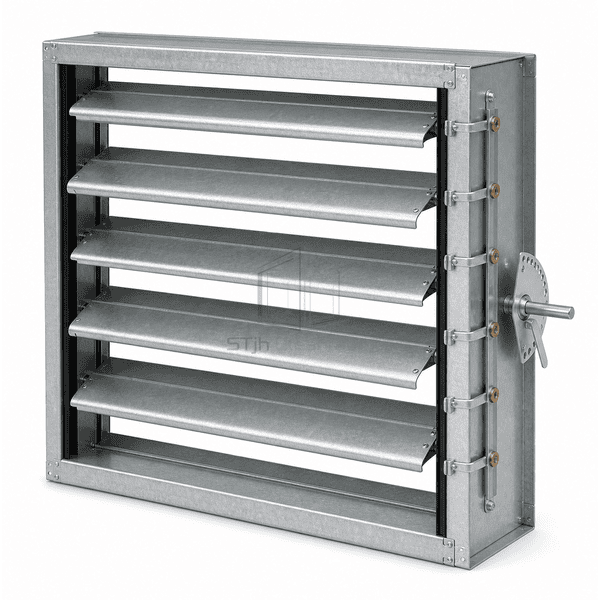
A rectangular multiblade damper whose adjacent linked blades rotate in opposite directions for stable duct volume control and compact shutoff.
- True Opposed Blade Action
- External Linkage
- Low-Leakage Edge Seals
- Manual or Motorized Drive
Product Introduction
The opposed blade volume control damper regulates air through rectangular cleanroom branches, equipment inlets and wall openings. Alternating aerofoil blades rotate toward and away from each other through an external linkage, dividing the throttling effect across the full face rather than concentrating it at one edge. A rigid channel frame keeps blade shafts aligned, while tip and side seals reduce closed-position leakage. The drive remains outside the airstream and can accept a manual quadrant, electric actuator or pneumatic operator.
Key Features
External linkage keeps moving joints out of the primary air path and visible for inspection.
Formed aerofoil blades resist vibration and reduce pressure loss when fully open.
Side and blade-tip seals limit bypass when the damper is used for branch isolation.
Customer Product Concerns
A balancing damper must provide stable modulation without blade chatter, distorted downstream flow or excessive closed-position leakage.
Parallel blades push most throttled airflow toward one side of the downstream duct.Opposed blade motion divides the openings across the face and produces a more balanced discharge profile.
Large blades twist or chatter under high duct velocity.Double-skin aerofoil sections and intermediate shaft supports maintain blade rigidity across wider dampers.
Internal linkage cannot be inspected without opening contaminated ductwork.The drive arm, transverse link and blade connectors are mounted outside the casing.
Air continues leaking through a nominally closed branch.Compressible blade-tip and side seals close the remaining gaps between aerofoil blades and frame.
Typical Applications
Cleanroom branch duct balancingAir-handler inlet and discharge controlSupply and extract isolationPlenum pressure adjustmentProcess exhaust volume regulation
Technical Parameters
Representative material and dimensional ranges for a rectangular opposed blade control damper are listed below.
| Core Material | Galvanized-steel or 304 stainless-steel channel frame with linked double-skin aerofoil blades |
|---|---|
| Panel Thickness | 1.0–2.0 mm frame channels and double-skin blade sheets |
| Effective Width | 200–2000 mm nominal single-section width |
| Maximum Length | Up to 2000 mm single-section width, with subdivided assemblies for larger openings |
| Steel Facing Thickness | 1.0–2.0 mm galvanized or stainless frame and blade material |
| Core Density | Approximately 7850 kg/m³ for galvanized-steel frame and blade construction |
| Thermal Conductivity | Approximately 45–60 W/(m·K) for galvanized-steel frame and blade construction |
| Surface Finish | Mill-galvanized, white powder-coated or brushed stainless-steel finish |
| Joint Type | Flanged rectangular frame with external opposed-action linkage and sealed blade edges |
| Customization | Available based on the intended application and operating environment. |
Available Options
Galvanized steel or 304 stainless steelManual quadrant, electric actuator or pneumatic driveLow-leakage blade and jamb sealsFlanged, drilled or corner-hole duct frame
Planning a Opposed Blade Volume Control Damper specification?
Send us your dimensions, installation conditions, performance targets and required surface finish.