
 EnglishCurrent
 德语
德语 阿拉伯语
阿拉伯语 法语
法语 印尼语
印尼语 日语
日语 韩语
韩语 马来语
马来语 葡萄牙语
葡萄牙语 俄语
俄语 西班牙语
西班牙语 泰语
泰语 土耳其语
土耳其语 越南语
越南语

Air Filters and Chemical Filtration
AMC Filter for Semiconductor Cleanrooms
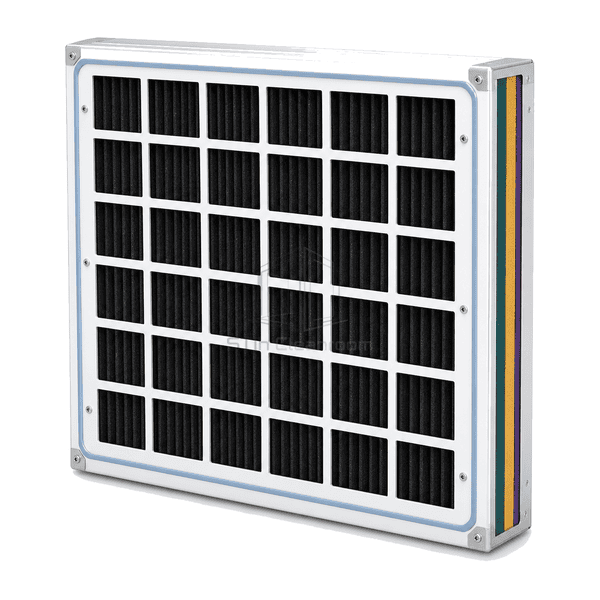
A low-outgassing pleated molecular panel formulated to control airborne acids, bases, VOCs or selected dopants in semiconductor cleanrooms and process equipment.
- Semiconductor AMC Control
- Low-Outgassing Components
- Targeted Pleated Adsorbents
- FFU-Compatible Panel
Product Introduction
The AMC filter for semiconductor cleanrooms embeds activated carbon, ion-exchange resin or chemically modified adsorbent within a clean pleated support. The resulting panel provides substantially more active area than a flat granular screen while keeping the shallow depth required by fan filter units, return-air modules and process tools. Different media layers can target volatile organics, acids, bases or selected dopant compounds. Low-outgassing frame, separator, gasket and potting materials help the finished filter operate near contamination-sensitive wafer, display and storage processes.
Key Features
Media chemistry can be selected for VOC, acid, base or dopant contamination rather than using one universal carbon grade.
Low-outgassing support and frame materials reduce the filter assembly's own contribution to the clean environment.
Clean retaining layers limit adsorbent particle shedding toward downstream HEPA or ULPA media.
Customer Product Concerns
Molecular contamination can alter wafer surfaces or corrode process hardware even when the cleanroom already meets its particulate classification.
Particle filters do not remove airborne acids, bases or volatile organic molecules.Embedded molecular adsorbents capture or react with the selected gas family before it reaches the process.
One broad-spectrum carbon grade cannot address multiple semiconductor AMC groups equally.Separate acid, base, VOC and dopant media layers can be arranged for the identified contaminant profile.
Loose chemical pellets shed dust toward a downstream ULPA terminal.Pleated embedded media and clean support scrims contain the adsorbent within the panel structure.
A deep chemical bed will not fit an FFU or process-tool return module.The high-area pleated panel provides a compact AMC stage in standard shallow cleanroom dimensions.
Typical Applications
Semiconductor wafer cleanroomsLithography and coating process toolsFlat-panel and OLED manufacturingChemical-sensitive storage cabinetsFFU and recirculation-air AMC stages
Technical Parameters
Typical construction ranges for a low-outgassing semiconductor AMC panel are listed below.
| Core Material | Pleated activated-carbon, ion-exchange or chemically impregnated adsorbent embedded in a low-outgassing support |
|---|---|
| Panel Thickness | 25–100 mm overall cleanroom-panel depth |
| Effective Width | 305–610 mm nominal face width |
| Maximum Length | Up to 1220 mm nominal face length |
| Steel Facing Thickness | 0.4–0.6 mm low-shedding stainless or coated retaining grid when specified |
| Core Density | Approximately 60–180 kg/m³ equivalent embedded-adsorbent media density |
| Thermal Conductivity | Approximately 0.040–0.090 W/(m·K) for the dry pleated adsorbent composite |
| Surface Finish | Natural anodized aluminium or clean low-outgassing polymer frame |
| Joint Type | Flat gasket, gel-compatible perimeter or clip-in FFU cassette connection |
| Customization | Available based on the intended application and operating environment. |
Available Options
VOC-targeted activated carbonAcid-gas chemisorption mediaAmmonia and amine ion-exchange mediaSingle-layer or multi-layer AMC cassette
Planning a AMC Filter for Semiconductor Cleanrooms specification?
Send us your dimensions, installation conditions, performance targets and required surface finish.