 EnglishCurrent
 德语
德语 阿拉伯语
阿拉伯语 法语
法语 印尼语
印尼语 日语
日语 韩语
韩语 马来语
马来语 葡萄牙语
葡萄牙语 俄语
俄语 西班牙语
西班牙语 泰语
泰语 土耳其语
土耳其语 越南语
越南语

Cleanroom Testing and Validation Instruments
Vibration Meter
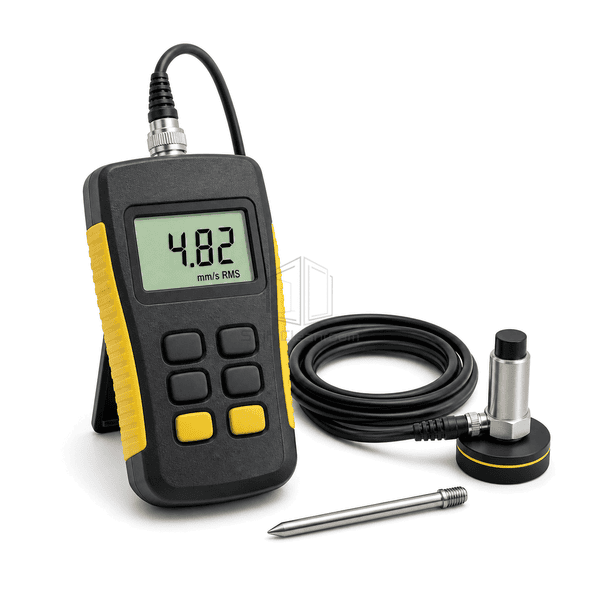
A handheld vibration meter with a cabled piezoelectric accelerometer, coiled lead, magnetic base and contact probe for repeatable machinery condition checks.
- Acceleration, velocity and displacement.
- External cabled accelerometer.
- Magnetic base and probe mounting.
Product Introduction
This portable instrument separates the display from a single external piezoelectric accelerometer so the sensor can remain firmly coupled to a motor, fan, pump or air-handling unit while the technician reads the result. Selectable acceleration, velocity and displacement modes describe different aspects of machine motion, with peak acceleration supporting high-frequency screening, RMS velocity indicating overall severity and peak-to-peak displacement representing movement amplitude. A magnetic base improves repeatability on clean ferrous surfaces, while a threaded contact probe provides fast comparative checks where magnetic attachment is impractical.
Key Features
Acceleration, velocity and displacement modes support bearing, overall-machine and motion-amplitude checks.
Selectable low- and high-frequency bands help separate rotational vibration from higher-frequency impacts.
RMS, Peak and peak-to-peak indications match the selected vibration quantity and survey method.
Coiled sensor cable extends to machinery points while remaining compact during walk-around inspections.
Interchangeable magnetic base and stainless contact probe suit repeatable or rapid screening measurements.
Customer Product Concerns
Comparable machine-vibration readings require the same measurement point, axis, sensor coupling, frequency band and amplitude convention, because a change in mounting method can alter the observed response.
Readings can change when the sensor is moved to a different point, direction or mounting surface.A magnetic base and marked measurement location keep sensor position and orientation consistent for trend comparison.
One vibration value cannot describe both overall machine motion and short high-frequency impacts.Selectable velocity, displacement and acceleration modes present RMS, peak-to-peak and Peak quantities appropriate to the check.
Cable movement or tension can disturb a small accelerometer during measurement.The flexible coiled lead and molded strain relief allow a slack service loop beside the mounted sensor.
Some housings are curved, painted or non-magnetic and cannot hold a flat magnetic base securely.An interchangeable stainless contact probe supports quick comparative screening when rigid magnetic coupling is unavailable.
Typical Applications
Cleanroom air-handling-unit vibration surveysMotor, fan and pump condition screeningBearing-housing comparative measurementsEquipment commissioning and post-maintenance checksRoutine trend collection at marked machine points
Technical Parameters
Representative construction for a professional handheld vibration meter is listed below; sensor sensitivity, filter range, mounting accessory and data-transfer functions can be selected for the machinery survey plan.
| Core Material | PC/ABS handheld enclosure with TPE grip, piezoelectric accelerometer, stainless sensor shell and probe, neodymium magnetic base, copper coiled cable and digital electronics |
|---|---|
| Panel Thickness | Typically 2.0-3.0 mm for the molded handheld enclosure wall |
| Effective Width | Approximately 70-90 mm across the handheld indicator |
| Maximum Length | Approximately 180-220 mm for the indicator and 1000-1500 mm for the extended coiled sensor cable |
| Steel Facing Thickness | Typically 0.8-1.5 mm for the accelerometer shell, contact probe and threaded inserts |
| Core Density | Approximately 1100-1200 kg/m³ for the PC/ABS enclosure blend |
| Thermal Conductivity | Approximately 0.19-0.22 W/(m·K) for the PC/ABS enclosure blend |
| Surface Finish | Dark-charcoal fine-texture housing, high-visibility yellow TPE grips, green backlit LCD, black coiled cable, satin stainless sensor and matte-black magnetic base |
| Joint Type | Locking sensor-cable connectors with strain relief and a threaded accelerometer base for interchangeable magnet or contact-probe mounting |
| Customization | Available based on the intended application and operating environment. |
Available Options
Low-frequency machinery vibration rangeHigh-frequency bearing acceleration rangeFlat or two-pole magnetic baseShort or extended contact probeUSB data-transfer interfaceProtective carrying case with sensor compartments
Planning a Vibration Meter specification?
Send us your dimensions, installation conditions, performance targets and required surface finish.