 EnglishCurrent
 德语
德语 阿拉伯语
阿拉伯语 法语
法语 印尼语
印尼语 日语
日语 韩语
韩语 马来语
马来语 葡萄牙语
葡萄牙语 俄语
俄语 西班牙语
西班牙语 泰语
泰语 土耳其语
土耳其语 越南语
越南语

Industry-Specific Cleanroom Equipment
Class III Biosafety Cabinet
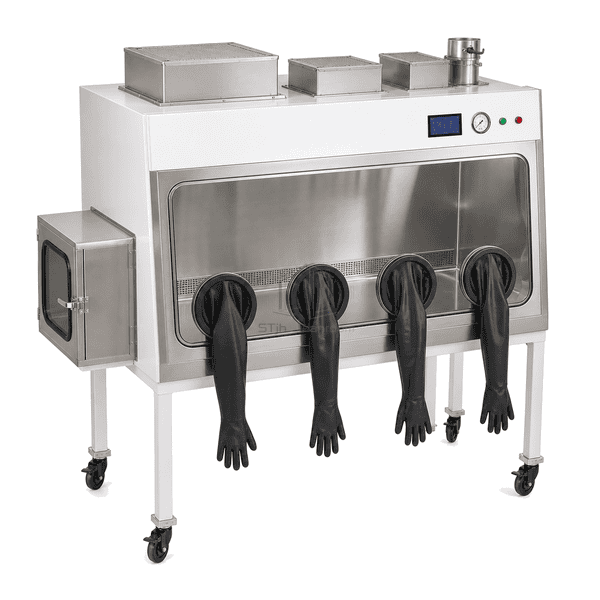
A fully enclosed negative-pressure biosafety cabinet that separates the operator from the work through a fixed viewing barrier and four attached gauntlets, with an interlocked material pass-through, filtered supply air and two-stage exhaust filtration.
- Gas-Tight Negative-Pressure Enclosure
- Four Fixed Gauntlet Ports
- Single-HEPA Supply and Double-HEPA Exhaust
- Interlocked Material Pass-Through
Product Introduction
The Class III Biosafety Cabinet is a completely enclosed, ventilated glove-operated workstation for laboratory processes that require a physical barrier around the manipulation zone. Unlike an open-front Class II cabinet, the selected four-port configuration has one fixed sealed observation window and four mechanically attached neoprene gauntlets, so routine hand access does not create an open working aperture. Room air enters through one dedicated HEPA stage, while cabinet air leaves through two HEPA stages in series and a hard-duct exhaust collar; the connected exhaust system is selected to keep the work enclosure below the surrounding room pressure. A double-ended side pass-through uses a one-door-at-a-time interlock to move closed materials without opening the main chamber. The satin AISI 304 work zone is contained within a white powder-coated steel shell and supported on a mobile leveling stand. A local display, differential-pressure gauge and separate green-red status indicators make operating and alarm conditions visible. Final pressure, exhaust capacity, filter arrangement, transfer method and facility connection are configured for the site's risk assessment rather than inferred from the cabinet name alone.
Key Features
One filtered supply path and two serial exhaust filter stages are paired with a dedicated duct collar so the facility exhaust can maintain inward leakage and negative cabinet pressure.
The integral double-ended transfer chamber uses opposing gasketed doors and a one-door-at-a-time interlock; it is a containment transfer route, not an autoclave or automatic sterilizer.
A local pressure gauge, control display and separate normal-alarm indicators provide direct feedback without opening the cabinet or relying only on a remote building interface.
Customer Product Concerns
A Class III cabinet must keep the work zone physically closed, maintain a reliable filtered pressure path and provide a material route that does not bypass the containment boundary.
An open sash can allow contaminated aerosols to escape when room airflow, operator movement or cabinet inflow is disturbed.The fixed sealed viewing barrier and four attached gauntlets eliminate the normal open-front work aperture used by Class I and Class II cabinets.
A single exhaust filter or uncontrolled fan connection may not provide the staged discharge path required by a high-containment design.The selected architecture routes air through two exhaust HEPA stages in series and a dedicated hard-duct collar while the connected extract system maintains negative pressure.
Introducing supplies through the main work enclosure would interrupt the sealed boundary and expose the process to an uncontrolled opening.One integral double-ended pass-through keeps its inner door closed while the outer door is used, then reverses the interlock sequence for controlled transfer.
Operators need an immediate indication if cabinet pressure or airflow changes during glove-port work.The round differential-pressure gauge, control display and separate green-red status lights make the configured operating and alarm state visible at the cabinet face.
Typical Applications
Glove-operated microbiology procedures where a documented risk assessment requires a completely enclosed primary containment barrierAerosol-generating laboratory manipulations that must remain inside a sealed negative-pressure work chamberHigh-containment research workflows that use a dedicated exhaust connection and staged exhaust filtrationClosed transfer and handling of compatible samples, tools and waste containers through an interlocked side chamber
Technical Parameters
Representative configurable construction values for the illustrated four-gauntlet, negative-pressure Class III cabinet are listed below.
| Core Material | Fully welded gas-tight AISI 304 stainless-steel work enclosure with a white powder-coated electro-galvanized external shell, fixed safety glazing, neoprene gauntlets and gasketed HEPA housings |
|---|---|
| Panel Thickness | 1.2 mm nominal AISI 304 work-zone panel |
| Effective Width | 1430 mm nominal internal work-zone width for the selected four-port configuration |
| Maximum Length | Up to 1995 mm nominal overall equipment length including the integral side pass-through in the selected configuration |
| Steel Facing Thickness | 1.5 mm nominal powder-coated steel external facing |
| Core Density | 7900 kg/m³ for representative AISI 304 stainless-steel components |
| Thermal Conductivity | 15 W/(m·K) for representative AISI 304 stainless steel at room temperature |
| Surface Finish | White powder-coated exterior, neutral silver satin AISI 304 work zone, colorless clear glazing, charcoal-black gauntlets and seals, dark-blue display, green and red status lenses |
| Joint Type | Fully welded gas-tight enclosure with a fixed sealed viewing panel, four mechanically clamped gauntlet ports, an interlocked double-ended pass-through and a hard-connected single-supply/double-exhaust HEPA path |
| Customization | Available based on the intended application and operating environment. |
Available Options
Alternative work-zone widths and glove-port arrangements while preserving the fully enclosed Class III barrierPass-through size, side orientation and transfer-door control selected for the intended load pathGas-tight supply and exhaust dampers, remote extract interface and facility-specific alarm contactsAlternative gauntlet materials and sizes, glove integrity test provisions and filter test injection ports
Planning a Class III Biosafety Cabinet specification?
Send us your dimensions, installation conditions, performance targets and required surface finish.