
 EnglishCurrent
 德语
德语 阿拉伯语
阿拉伯语 法语
法语 印尼语
印尼语 日语
日语 韩语
韩语 马来语
马来语 葡萄牙语
葡萄牙语 俄语
俄语 西班牙语
西班牙语 泰语
泰语 土耳其语
土耳其语 越南语
越南语

Cleanroom Utility Systems
Vacuum Receiver
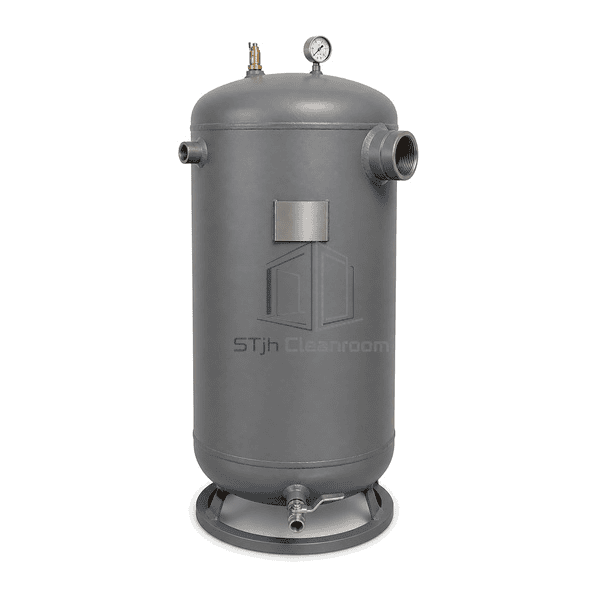
A standalone 120-gallon vertical carbon-steel receiver that adds evacuated buffer volume between a vacuum header and pump, with a full-vacuum/150 psi design boundary, dedicated gauge and safety connections, and a low-point manual drain.
- 120 US gallon vertical buffer volume
- Rated for full vacuum and 150 psi
- Dedicated gauge, safety and drain connections
Product Introduction
The Vacuum Receiver is a standalone welded vessel for stabilizing an industrial vacuum header when process demand changes faster than the connected pump can respond. The selected purchasable basis is one Penway A7120-class 120 US gallon vertical receiver with carbon-steel shell and elliptical heads, neutral gray primer, threaded service openings and one circular base-ring support. Its evacuated volume absorbs short suction peaks and lengthens the interval between pump start/stop events, while the bottom head provides a defined low point for liquid that passes the upstream protection stage. The vessel creates no vacuum by itself: it is not the duplex pump-and-control station used for ID 1927, not the positive-pressure compressed-air receiver used for ID 1917 and not an atmospheric process-storage tank.
Key Features
Full-vacuum external-pressure design resists atmospheric collapse when the internal pressure approaches zero absolute
A 150 psi positive-pressure boundary gives the welded vessel a clearly defined two-direction design envelope
Elliptical welded heads distribute shell loads more smoothly than flat end plates and keep the vessel compact
One 3-inch-class main connection and one 2-inch-class secondary connection support a low-restriction header arrangement
Separate gauge and safety/vent couplings keep indication and protective accessories independent of the process connections
A bottom manual drain provides a controlled low point for liquid removal after the receiver is isolated and returned to atmospheric pressure
The continuous base ring spreads the vessel load around its circumference without projecting individual support legs into the service area
Customer Product Concerns
Receiver selection depends on usable evacuated volume, allowable pressure boundaries, pump control band, demand profile, line conductance, gas chemistry and the amount of liquid or solids that may reach the header.
A receiver selected only by nominal gallons may still be too small to absorb the peak flow between the high- and low-vacuum control pointsSize usable volume from the actual demand pulse, permitted pressure swing and pump response time, then verify the result against header conductance.
An ordinary thin-wall storage tank can buckle when exposed to full external atmospheric pressureUse a vessel with an explicit full-vacuum design boundary and keep the original nameplate and fabrication documentation traceable to the selected tank.
Condensate or cleaning liquid can collect in the bottom head and reduce usable volume or contaminate downstream serviceProvide upstream separation where carryover is expected, inspect the low point and drain only after isolation and return to atmospheric pressure.
Small nozzles, tight elbows or long branch runs can erase the response benefit of added receiver volumeKeep the main connection and header path short, size the line for the peak suction flow and avoid unnecessary restrictions near the receiver.
A corrosive or solvent-laden gas stream can attack carbon steel, primer and accessory elastomersReview the complete gas and condensate chemistry and select stainless construction, compatible coating and seal materials when carbon steel is unsuitable.
Poor foundation support or external pipe loads can distort nozzles and stress the welded shellSeat the base ring on a level load-bearing pad, anchor it evenly and support connected piping independently of the vessel nozzles.
Typical Applications
Central utility vacuum headers serving intermittent cleanroom and laboratory demand pointsPharmaceutical vessel evacuation systems where short suction peaks need additional buffer volumeVacuum packaging, pick-and-place and material-transfer systems with cyclic demandFiltration and drying processes that require a steadier header pressure during valve changesDegassing and evacuation skids where a standalone receiver is installed between the process and pump trainIndustrial vacuum networks that need a drainable collection low point downstream of suitable inlet separation
Technical Parameters
The locked catalogue identity is one unbranded Penway A7120-class vertical industrial vacuum receiver. It contains exactly one medium-gray primer-coated carbon-steel cylindrical shell, one elliptical top head, one elliptical bottom head, one 3-inch-class upper main threaded connection, one 2-inch-class secondary threaded connection, one 1/2-inch instrument coupling with one round analog gauge, one 1/4-inch safety/vent coupling with one compact brass safety fitting, one 1-1/2-inch bottom manual drain, one blank rectangular metal nameplate and one continuous circular base ring with reinforcing gussets. It has zero manways, zero pumps, zero motors, zero filters, zero control cabinets, zero discrete legs and zero footplates. The manufacturer drawing lists 120 US gallons, 24-inch diameter, 67-inch tangent length, about 75-inch overall height, 360 lb weight, 150 psi and full-vacuum design boundary, carbon steel, gray primer and base-ring support.
| Core Material | Welded carbon-steel cylindrical shell and elliptical heads with stainless-steel drain hardware, brass safety fitting and project-compatible seals |
|---|---|
| Panel Thickness | 6 mm nominal carbon-steel cylindrical shell basis |
| Effective Width | 610 mm vessel outside-diameter basis |
| Maximum Length | 1905 mm nominal overall vertical height |
| Steel Facing Thickness | 8 mm nominal formed carbon-steel head basis |
| Core Density | Approximately 7850 kg/m³ for the principal carbon-steel shell and heads |
| Thermal Conductivity | Approximately 45-60 W/(m·K) for the principal carbon-steel structure at ambient temperature |
| Surface Finish | Neutral medium-gray industrial primer on the exterior, as-welded carbon-steel interior and natural metal accessories |
| Joint Type | 3-inch NPT main vacuum connection, 2-inch NPT secondary connection, 1/2-inch gauge port, 1/4-inch safety/vent port and 1-1/2-inch NPT bottom drain |
| Customization | Available based on the intended application and operating environment. |
Available Options
Alternative receiver volume and vertical or horizontal orientation matched to the calculated demand cycle304 or 316 stainless-steel vessel construction for compatible corrosive or high-cleanliness serviceSpecial internal lining or exterior coating selected for the gas, condensate and installation environmentFlanged or threaded main connections with application-sized nozzle diameters and orientationsVacuum gauge, absolute-pressure transmitter or compound pressure transmitterVacuum breaker, pressure-relief accessory and isolation valve selected for the defined operating envelopeAutomatic or manual low-point drain with liquid-level indication for carryover-prone dutiesAlternative base ring, mounting feet or engineered support arrangement for the installation foundation
Planning a Vacuum Receiver specification?
Send us your dimensions, installation conditions, performance targets and required surface finish.