
 EnglishCurrent
 德语
德语 阿拉伯语
阿拉伯语 法语
法语 印尼语
印尼语 日语
日语 韩语
韩语 马来语
马来语 葡萄牙语
葡萄牙语 俄语
俄语 西班牙语
西班牙语 泰语
泰语 土耳其语
土耳其语 越南语
越南语

Cleanroom Utility Systems
Vacuum Exhaust HEPA Filter
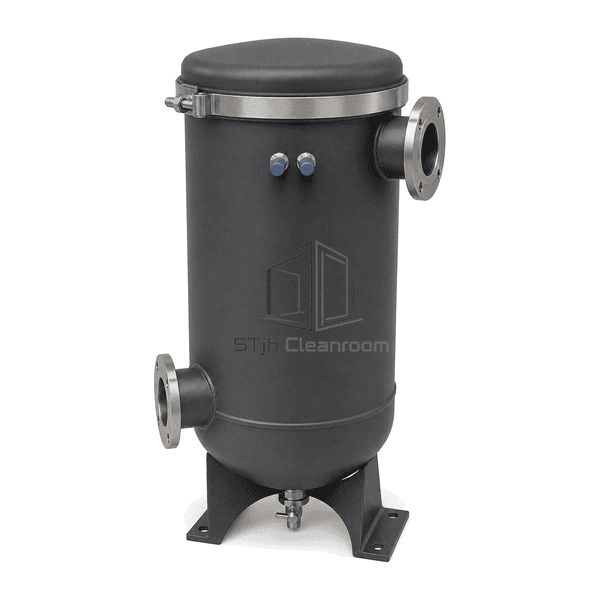
A remotely piped HEPA-grade discharge unit that captures fine particulate released by a compatible dry vacuum pump before the exhaust reaches a room or facility duct, while providing serviceable pressure taps, condensate drainage and a stable mounting base.
- Downstream dry-pump exhaust filtration
- 99.99% particulate efficiency at 0.3 µm family basis
- Full-vacuum housing with 90°C temperature limit
Product Introduction
The Vacuum Exhaust HEPA Filter is a complete pump-discharge assembly for clean utilities, laboratories and controlled production areas where dry-scroll tip-seal dust or other fine particles must not be released directly into the occupied space. The locked configuration uses one vertical full-vacuum housing with a single pleated borosilicate microglass cartridge, separate low and high pipe connections, two differential-pressure take-off ports, a low-point drain and a two-foot base. Its flow path is downstream of the pump, so it differs fundamentally from a sanitary vacuum-line sterile filter installed on the suction side. The unit is not an oil-vapour adsorber, does not replace source-specific gas treatment and should be preceded by a suitable coalescing separator when a lubricated pump produces significant oil mist.
Key Features
Full-vacuum-capable housing construction tolerates reverse pressure conditions that may occur during shutdown or abnormal line sequencing
A 90°C housing-family temperature boundary accommodates warm discharge from correctly selected dry vacuum pumps
Separate lower inlet and upper outlet connections support a vertical upward flow path and remote exhaust piping
Two capped pressure take-offs allow clean and loaded differential pressure to be measured without a permanently mounted gauge
The low-point drain provides a controlled way to remove incidental condensate after the unit is isolated and depressurized
A removable top cover and circumferential clamp band give direct access to the single replaceable cartridge
The saddle base with two mounting feet transfers pipe and service loads to the floor or skid instead of the filter connections
Customer Product Concerns
Reliable pump-exhaust filtration depends on the pump technology, maximum discharge temperature, gas chemistry, pressure pulsation, condensate load, pipe backpressure and the acceptable terminal pressure drop.
Dry-scroll tip-seal dust can be discharged into a clean technical room even when the process suction line is already filteredPlace the HEPA unit after the pump and before the room outlet or facility exhaust connection so pump-generated particles encounter the final cartridge.
A small exhaust element can raise backpressure, increase pump temperature and reduce evacuation performance as it loadsSize the cartridge and pipe connections from the pump's free-air displacement, allowable exhaust backpressure and clean-to-change differential-pressure limit.
Warm discharge or process vapour can damage media, seals or a plastic filter bowlVerify the worst-case exhaust temperature and gas compatibility against the 90°C housing-family boundary and select a lower upstream cooling or treatment stage when required.
Condensate collecting at the bottom of a vertical exhaust housing can wet the HEPA pack and sharply increase resistanceKeep the unit upright, slope connecting pipework appropriately and drain the isolated low point before liquid reaches the filter media.
An exhaust filter may see reverse vacuum during pump shutdown or valve sequencingUse a documented full-vacuum housing and confirm the closure, flanges, drain and pressure-port blanks share the required bidirectional pressure boundary.
HEPA, oil-mist coalescing and vapour adsorption are often treated as interchangeable exhaust controlsDefine the contaminant first: use this HEPA stage for particles, add a coalescer for lubricant aerosol and add compatible adsorption or catalytic treatment for gases and vapours.
Typical Applications
Dry scroll vacuum pump exhaust serving cleanroom production equipmentLaboratory vacuum systems that must prevent pump-generated particles from entering occupied roomsLyophilizer and chamber evacuation skids with compatible dry-pump dischargeSemiconductor and precision-process vacuum utilities handling non-corrosive particulate exhaustMedical and research equipment requiring a remotely piped final particulate barrier after the pumpClean utility packages that monitor exhaust-filter differential pressure and planned element replacement
Technical Parameters
The catalogue-scale basis is one vertical Walker T-Series-class housing in a dry-pump exhaust particulate configuration. The conservative housing-family limits are full vacuum to 0.5 barg and 90°C. One borosilicate microglass cartridge is selected for 99.99% particulate efficiency at 0.3 µm, with an FKM seal, a lower inlet, upper outlet, two differential-pressure take-offs, low-point drain, removable cover clamp and two-foot support. Dimensions below define a representative medium-flow remote unit for consistent product presentation; connection size, media area and change differential remain selectable for the actual pump flow and backpressure allowance.
| Core Material | One deep-pleated HEPA-grade borosilicate microglass cartridge with synthetic drainage layers, perforated metal support cylinders and an FKM seal |
|---|---|
| Panel Thickness | 45 mm nominal radial pleated-media pack depth for the representative single-cartridge configuration |
| Effective Width | 180 mm nominal cylindrical housing diameter excluding pipe ports and pressure take-offs |
| Maximum Length | 520 mm nominal overall height including cover, drain and two-foot mounting base |
| Steel Facing Thickness | 2.0 mm representative powder-coated steel cover, support saddle and mounting-foot thickness |
| Core Density | Approximately 120 kg/m³ representative effective bulk density for the finished pleated microglass media pack |
| Thermal Conductivity | Approximately 0.040 W/(m·K) representative of dry low-density borosilicate microglass media near ambient temperature |
| Surface Finish | Deep-graphite impact-resistant housing finish with neutral zinc-plated or stainless port, clamp, drain and mounting hardware |
| Joint Type | One lower inlet and one upper outlet with removable pipe flanges, one circumferential cover clamp, two capped differential-pressure ports and one low-point drain |
| Customization | Available based on the intended application and operating environment. |
Available Options
Connection sizes and flange standards matched to dry-pump exhaust flowAlternative HEPA element area for the allowable clean and loaded pressure dropHigher-temperature media and seal package for compatible warm gas serviceStainless-steel housing and base for corrosive or high-cleanliness locationsRemote differential-pressure gauge or transmitter connected to the two take-off portsManual or automatic condensate drain arrangement for the expected moisture loadInternal over-pressure relief setting coordinated with pump and exhaust-line limitsUpstream oil-mist coalescer or vapour-treatment stage selected for non-dry pump technologies
Planning a Vacuum Exhaust HEPA Filter specification?
Send us your dimensions, installation conditions, performance targets and required surface finish.