
 EnglishCurrent
 德语
德语 阿拉伯语
阿拉伯语 法语
法语 印尼语
印尼语 日语
日语 韩语
韩语 马来语
马来语 葡萄牙语
葡萄牙语 俄语
俄语 西班牙语
西班牙语 泰语
泰语 土耳其语
土耳其语 越南语
越南语

Cleanroom Testing and Validation Instruments
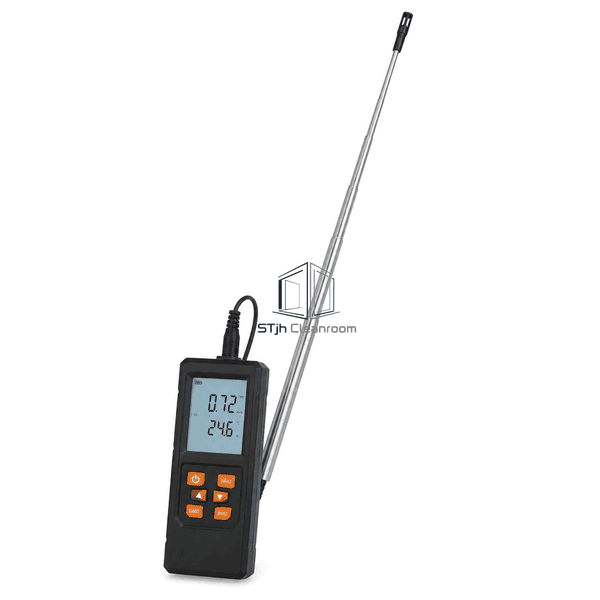
Thermal Anemometer
A precision hot-wire thermal anemometer for low air-velocity measurement, temperature indication and cleanroom airflow surveys at grilles, hoods and open work zones.
- Sensitive hot-wire measurement for low-speed cleanroom air.
- Slim telescopic probe with minimal flow disturbance.
- Averaging and logging for structured airflow traverses.
Product Introduction
This thermal anemometer uses a heated miniature sensor whose cooling response tracks local air velocity with high sensitivity at low speeds. A slim telescopic probe enters grilles, ducts and confined test locations with limited flow disturbance, while the handheld meter provides velocity, temperature, averaging and data-storage functions for systematic qualification work.
Key Features
Slim telescopic probe reaches ducts and overhead outlets with minimal flow obstruction.
Simultaneous velocity and air-temperature readings support ventilation diagnostics.
Timed and multi-point averaging stabilizes measurements in fluctuating air streams.
Selectable duct area enables calculated volumetric-flow results.
Stored readings can support traverse records and qualification documentation.
Customer Product Concerns
Low-speed unidirectional airflow requires a sensitive sensor that can enter restricted test points without materially changing the velocity being measured.
Very low cleanroom air speeds can fall below the useful sensitivity of a compact vane.A heated miniature sensor responds to small changes in convective cooling for dependable low-velocity readings.
A bulky probe can disturb the flow inside a grille or narrow duct.The slender telescopic shaft and small sensor tip reduce blockage at the measurement point.
Local turbulence makes a single instantaneous value unrepresentative.Timed and multi-point averaging produces a more stable result across the prescribed traverse.
Long qualification surveys are vulnerable to transcription errors.Onboard storage keeps point readings and statistics available for later review and reporting.
Typical Applications
Cleanroom low-velocity airflow mappingLaminar-flow hood and workstation verificationSupply grille and diffuser traversesDuct velocity and volume-flow testingVentilation commissioning and troubleshooting
Technical Parameters
Representative construction dimensions for a handheld hot-wire instrument are listed below; probe geometry, sensing range and environmental channels can be selected for the validation protocol.
| Core Material | Miniature heated-film sensor, stainless telescopic probe and impact-resistant polymer handheld housing |
|---|---|
| Panel Thickness | Typically 2.0-3.0 mm for the molded meter enclosure |
| Effective Width | Approximately 7-12 mm across the protected probe tip |
| Maximum Length | Approximately 900-1100 mm with the telescopic probe fully extended |
| Steel Facing Thickness | Typically 0.3-0.8 mm for the stainless telescopic probe sections |
| Core Density | Approximately 7800-8000 kg/m³ for stainless probe components |
| Thermal Conductivity | Approximately 14-17 W/(m·K) for stainless probe components |
| Surface Finish | Dark graphite overmolded meter with satin stainless probe and black protective sensor tip |
| Joint Type | Locking telescopic sections with keyed detachable probe connection and protected sensing window |
| Customization | Available based on the intended application and operating environment. |
Available Options
Straight or articulating telescopic probeVelocity and temperature probeHumidity-capable probe configurationProtective instrument caseData-download softwareTraceable calibration service
Planning a Thermal Anemometer specification?
Send us your dimensions, installation conditions, performance targets and required surface finish.