 EnglishCurrent
 德语
德语 阿拉伯语
阿拉伯语 法语
法语 印尼语
印尼语 日语
日语 韩语
韩语 马来语
马来语 葡萄牙语
葡萄牙语 俄语
俄语 西班牙语
西班牙语 泰语
泰语 土耳其语
土耳其语 越南语
越南语

Cleanroom Utility Systems
Gas Emergency Shut-Off System
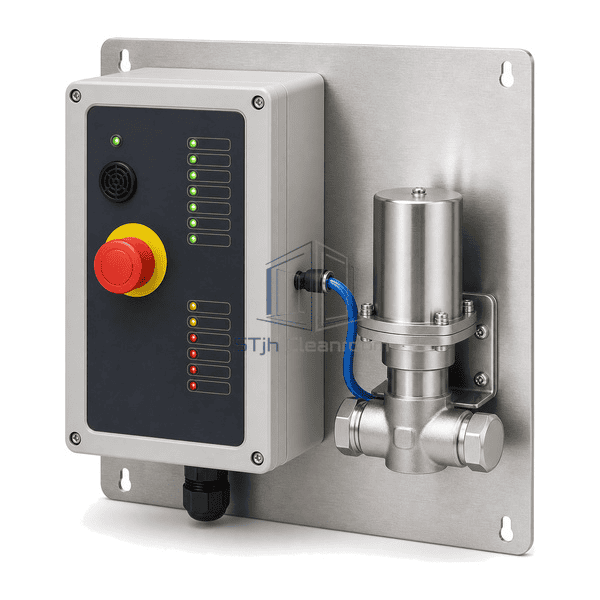
Integrated gas emergency shut-off controller and normally closed pneumatic diaphragm valve for isolating selected laboratory or clean-manufacturing gas sources after a detector, fire, process or manual emergency input.
- Automatic or manual isolation of selected gas sources
- Normally closed pneumatic valve removes flow when pilot pressure is vented
- Separate input, output, alarm and reset status at the controller
Product Introduction
The Gas Emergency Shut-Off System combines a wall-mounted safety controller with one or more high-purity pneumatic isolation valves. During normal operation, controlled pilot pressure holds each normally closed diaphragm valve open. A mapped gas detector, fire contact, process permissive or emergency-stop input causes the controller to vent that pilot pressure and isolate the corresponding gas source. Local status indication, an audible alarm, dry contacts and optional network access help operators identify the initiating channel without turning the shut-off assembly into the gas detector itself. The gas service, valve materials, cause-and-effect logic, reset method and proof-test interval are selected for the actual hazard and delivery system.
Key Features
Pneumatic fail-closed valve architecture converts loss of pilot pressure into a closed gas path
A prominent local mushroom button provides direct manual shutdown without navigating a display menu
Independent channel indicators show input and valve-command states for faster incident interpretation
Master and channel relay contacts can pass alarm, shutdown and fault information to a building or process system
A high-purity diaphragm valve with metal-to-metal body sealing limits added contamination in compatible gas service
Separate process and pilot connections keep hazardous gas out of the controller enclosure
Latched shutdown and deliberate reset options reduce unintended reopening after an alarm condition clears
Event and remote-status options support review of trips, resets and loss-of-utility conditions
Single- or multi-source arrangements can be configured without changing the basic fail-closed isolation principle
Customer Product Concerns
Effective emergency isolation depends on the complete cause-and-effect chain: the initiating contact, controller logic, pilot utility, shut-off valve and downstream trapped volume all need to behave as intended under fault conditions.
One alarm may need to close only the affected gas source while a fire input must isolate every channelBuild and document a channel matrix that maps each detector, fire, process and manual input to the required valve outputs.
A valve that depends on pilot pressure can remain unavailable if the air or nitrogen supply is weak or contaminatedProvide regulated clean pilot gas, supervise its pressure and test that loss of pilot pressure drives every connected valve closed.
Automatic reopening after a detector signal clears can reintroduce gas before the release has been investigatedUse latched shutdown and an intentional reset sequence that requires the initiating condition and site restart criteria to be cleared.
A controller can indicate shutdown even when a sticky actuator or incorrect tube connection prevents field isolationProof-test the complete loop at defined intervals and verify actual valve travel or downstream pressure decay, not only relay state.
Closing the source valve does not remove gas already trapped in downstream tubing or process equipmentCoordinate shut-off with compatible ventilation, purge, vent and process-safe actions based on the installed gas inventory.
Valve wetted materials or seals may be unsuitable for the selected corrosive or high-purity gasConfirm gas compatibility, pressure, flow, connection style and cleanliness before selecting the valve body and diaphragm package.
Typical Applications
Semiconductor and photovoltaic specialty-gas source isolationResearch laboratories using toxic, flammable, corrosive or high-purity gasesPharmaceutical utility and process-gas rooms requiring detector-linked shutdownGas cabinets, cylinder manifolds and changeover stations with remote emergency isolationClean manufacturing service corridors and equipment support areasCalibration, heat-treatment and pilot-process gas supply systems
Technical Parameters
The displayed product basis is a compact controller-and-single-valve assembly using a flame-retardant polycarbonate control enclosure, a separate 316L stainless steel normally closed pneumatic diaphragm valve and a brushed stainless mounting plate. The controller envelope is represented at approximately 363 mm high, 324 mm wide and 210 mm deep before the external valve and service clearances are added. The site's fixed ten-row schema uses panel-oriented labels; Steel Facing Thickness therefore distinguishes the molded enclosure from the separate mounting plate. Channel count, input logic, valve port size, pilot pressure and communication arrangement remain application-selected.
| Core Material | Flame-retardant polycarbonate controller enclosure with internal control electronics, paired with a 316L stainless steel normally closed pneumatic diaphragm valve and separate stainless mounting plate |
|---|---|
| Panel Thickness | 210 mm nominal controller depth for the selected catalogue basis, excluding the external valve and service clearance |
| Effective Width | 324 mm nominal controller width for the selected catalogue basis |
| Maximum Length | 363 mm nominal controller height, excluding pneumatic tubing, valve assembly and cable entries |
| Steel Facing Thickness | 0 mm steel facing on the molded controller enclosure; a separate approximately 2.0 mm stainless mounting plate may be supplied |
| Core Density | Approximately 1200 kg/m³ representative density for the unfilled polycarbonate enclosure material |
| Thermal Conductivity | Approximately 0.20 W/(m·K) near 23°C for representative unfilled polycarbonate |
| Surface Finish | Warm light-gray molded polymer enclosure, charcoal status panel, red/yellow emergency control, natural-silver stainless valve and backplate, and restrained multicolor status lenses |
| Joint Type | Normally closed pneumatic diaphragm valve with opposed threaded or face-seal process ports, separate pilot port, controller bulkhead connections and terminal or network interfaces |
| Customization | Available based on the intended application and operating environment. |
Available Options
Single-source or multi-source emergency isolation configurationsNormally open or normally closed detector and facility input logicGrouped or independent pneumatic valve-output mapping316L stainless high-purity diaphragm valves in selected port sizes and flow coefficientsGas-compatible threaded, tube-stub or face-seal process connectionsClean compressed-air or nitrogen pilot-gas arrangementsRemote emergency-stop stations, horns and status beaconsMaster and individual dry-contact alarm outputsWeb, email, fieldbus or building-management status integrationPilot-pressure supervision and valve-position feedback where required
Planning a Gas Emergency Shut-Off System specification?
Send us your dimensions, installation conditions, performance targets and required surface finish.