 EnglishCurrent
 德语
德语 阿拉伯语
阿拉伯语 法语
法语 印尼语
印尼语 日语
日语 韩语
韩语 马来语
马来语 葡萄牙语
葡萄牙语 俄语
俄语 西班牙语
西班牙语 泰语
泰语 土耳其语
土耳其语 越南语
越南语

Cleanroom Utility Systems
Dry Gas Scrubber
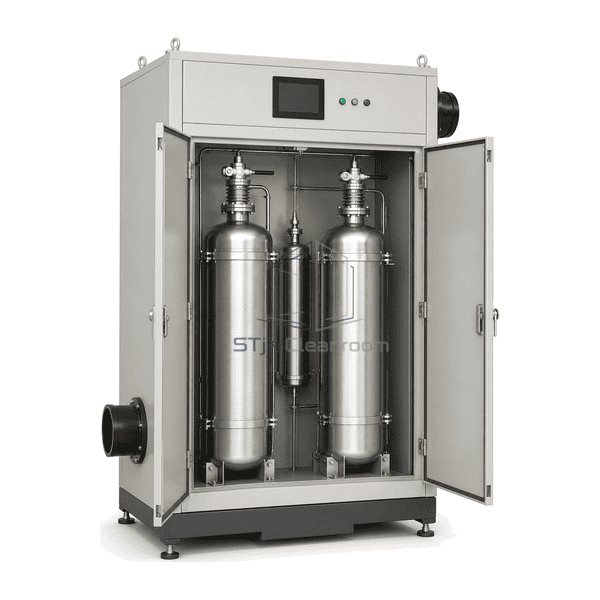
Point-of-use dry-bed chemisorption cabinet with sealed stainless absorber columns, gas-specific inorganic media, backup capacity and monitored purge and exhaust interfaces.
- Ambient-temperature irreversible chemisorption
- Gas-specific refillable stainless absorber columns
- Backup capacity with monitored purge and endpoint functions
Product Introduction
The Dry Gas Scrubber removes selected hazardous process gases by passing the exhaust through a dedicated inorganic chemisorber bed at ambient temperature. Compatible gas species react irreversibly with the selected granulate and remain as stable solid products within sealed 316L stainless absorber columns. The displayed production cabinet uses two full-size columns and a smaller backup column so a controlled sequence can isolate, purge and service one bed while maintaining an engineered safe state. Temperature, pressure, valve position and optional endpoint sensing connect to the local controller. Sorbent chemistry, capacity, column arrangement, purge method and changeout criteria are defined from the complete process-gas inventory and exhaust profile.
Key Features
Ambient-temperature operation avoids a continuously heated reaction chamber for suitable gases
Gas-specific inorganic media is selected for the actual process recipe rather than used as a universal bed
Refillable 316L stainless columns provide a sealed and reusable containment package
Integrated column valves isolate the spent bed before disconnection and handling
A dedicated backup column supports controlled completion or transition after primary-bed capacity is reached
Independent temperature and breakthrough monitoring can identify abnormal loading or approaching endpoint
Automated inert purge and leak-check routines support safer column change preparation
Sub-pressure control limits backpressure at connected process exhausts
Local HMI, event logging and remote interfaces provide clear operating and maintenance status
Customer Product Concerns
Dry-bed selection cannot be separated from the process recipe. Media compatibility, reaction heat, carrier flow, solids formation, pressure behavior, endpoint method and safe column changeout all require application-specific review.
One generic sorbent may have little capacity or an unsafe reaction profile for a newly introduced gasSubmit the complete process recipe, maximum gas flows and carrier streams so the media formulation and column size are selected together.
A concentrated transient release can generate heat faster than the bed can dissipate itEvaluate credible peak loads and provide column temperature monitoring, flow control, backup capacity and compatible inert cooling where required.
Breakthrough can occur without a visible change in the cabinet or a useful pressure-drop signalUse a compatible endpoint sensor or validated capacity model and define a conservative changeout trigger from actual process usage.
Process deposits can accumulate in inlet lines before gas reaches the absorber bedReview exhaust temperature, dilution, line geometry and maintenance access so condensable or reactive by-products do not obstruct the inlet.
Opening a column connection before isolation and purge can expose personnel to residual process gasInterlock integrated valves, confirm negative pressure, complete the specified inert purge and verify safe conditions before disconnection.
A power or facility interruption can leave an active process without the expected exhaust pathDefine fail-safe valve states, passive absorption path, backup bed and tool shutdown interface for each loss-of-utility scenario.
Typical Applications
Compound-semiconductor MOCVD exhaust with characterized hydride and metal-organic speciesSemiconductor plasma etch, deposition, chamber-clean and ion-implant support processesPhotovoltaic and display manufacturing processes using compatible hazardous gasesResearch and pilot tools requiring passive point-of-use treatment between operating campaignsSpecialty-chemical processes where a validated dry chemisorber formulation is available
Technical Parameters
The displayed basis is a dual-main-column dry scrubber cabinet approximately 1200 mm wide, 900 mm deep and 2050 mm high, with two full-size 316L absorber columns, one smaller backup column, integrated isolation valves and an upper control fascia. The site's fixed ten-row schema uses panel-oriented labels; Panel Thickness therefore means cabinet depth, while density and conductivity describe the stainless column shell rather than proprietary sorbent. Gas family, media formulation, usable capacity, purge flow, endpoint sensor and safety logic remain application-selected.
| Core Material | Refillable 316L stainless steel absorber columns containing gas-specific non-carbon inorganic chemisorber granulate |
|---|---|
| Panel Thickness | 900 mm representative overall cabinet depth including the internal column and valve envelope |
| Effective Width | 1200 mm representative dual-main-column cabinet width excluding service clearance |
| Maximum Length | 2050 mm representative cabinet height excluding site exhaust and purge connections |
| Steel Facing Thickness | 1.5 mm nominal powder-coated cabinet panels around separate pressure-retaining stainless columns |
| Core Density | Approximately 7900 kg/m³ representative density for the 316L stainless absorber-column shell |
| Thermal Conductivity | Approximately 15 W/(m·K) near room temperature for representative 316L stainless steel |
| Surface Finish | Warm light-gray powder-coated cabinet with natural-silver stainless columns, dark HMI and color-coded status indicators |
| Joint Type | Integrated column isolation valves with gasketed stainless bellows, purge fittings and flanged process-exhaust connections |
| Customization | Available based on the intended application and operating environment. |
Available Options
Single, dual or dual-main-plus-backup absorber-column arrangementChemisorber media selected for the characterized gas family and process recipeInfrared or contact temperature monitoring of each active columnCompatible endpoint detector and automatic bed-change alarmInert-gas purge, leak-check and cooling sequencesControlled vacuum or exhaust-pressure regulationTouchscreen HMI, event logging and remote industrial communicationsTool permissive, fault, alarm and emergency-shutdown interfacesAlternative compact laboratory or high-flow production cabinet size
Planning a Dry Gas Scrubber specification?
Send us your dimensions, installation conditions, performance targets and required surface finish.