 EnglishCurrent
 德语
德语 阿拉伯语
阿拉伯语 法语
法语 印尼语
印尼语 日语
日语 韩语
韩语 马来语
马来语 葡萄牙语
葡萄牙语 俄语
俄语 西班牙语
西班牙语 泰语
泰语 土耳其语
土耳其语 越南语
越南语

Cleanroom Cleaning, Disinfection and Sterilization
Sterile Purified Water
Sterile preservative-free purified water for non-parenteral cleanroom dilution, controlled rinsing, and manufacturing support.
- 100% purified water without antimicrobial preservatives, fragrances, surfactants, or active disinfectant residue
- Sterile presentation supports controlled dilution and rinse tasks where ordinary utility water is unsuitable
- Sealed small-mouth bottle provides clean, measured pouring without a trigger mechanism
Product Introduction
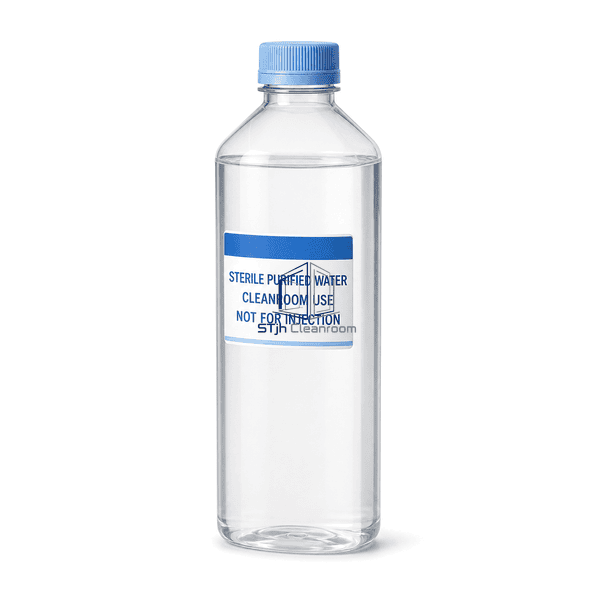
Sterile Purified Water is a clear, colorless, preservative-free aqueous product intended for cleanroom, laboratory, and manufacturing use rather than injection, infusion, sterile irrigation, or drinking. The slim 1 L transparent-to-natural bottle shows the remaining volume and clean water headspace without requiring a level window. Its narrow shoulders lead to a centered small-mouth threaded neck with a pale-blue ribbed tamper-evident cap, supporting controlled pouring into a qualified wipe, mop reservoir, measuring vessel, or solution-preparation container. Typical uses include diluting compatible sterile concentrates, rinsing detergent or disinfectant residue from hard surfaces, preparing non-parenteral process solutions, and final rinsing of suitable tools or components. Protected double-bag and larger capped formats can be selected according to the cleanroom transfer route and expected consumption.
Key Features
Clear, colorless, odorless, nonflammable liquid
0.2 micron filtered product configurations
Sterile or gamma-processed cleanroom presentations
No alcohol, detergent, oxidizer, or quaternary active
Visible water level in a transparent-to-natural narrow-shoulder bottle
Small-mouth threaded neck with tamper-evident screw cap
Double-bagged transfer and larger capped formats available
Customer Product Concerns
Water can dilute or remove chemical residue without adding volatile solvent, but it can also become a contamination vehicle when the wrong grade, an open container, or an unclean dispensing tool is used. Assuming that all sterile water is equivalent may introduce an unsuitable endotoxin or chemical-purity profile into a critical process. Repeatedly opening a bulk bottle increases exposure, while uncontrolled dilution changes disinfectant concentration and contact performance. Selecting the correct grade, matching pack size to one work session, using a closed or tamper-evident closure, controlling the transfer path, and defining the disposition of opened product keep the rinse or dilution step reproducible.
Is sterile purified water interchangeable with Water for Injection?No. Sterility describes microbial status, while purified water and WFI have different intended quality profiles and process uses. The water grade should be selected from the process requirement; a WFI-quality option is used when the required endotoxin control or product-contact specification is beyond the selected purified-water grade.
How is the opened bottle protected from recontamination?A tamper-evident small-mouth closure limits the exposed opening and supports controlled dispensing without installing a trigger. Pack size should match the expected work session, and the bottle should be recapped immediately, handled only in the defined area, and discarded at the approved in-use limit rather than returned to general stock.
Can inaccurate water addition weaken a disinfectant concentrate?Dilution should use a calibrated vessel, the exact concentrate-to-water ratio, and a documented final volume. Adding water by visual estimate is avoided, and the prepared solution is identified with the formulation and allowable hold time before it enters the application sequence.
Will purified water alone remove oily or strongly bound soil?Water is effective for soluble residue and final rinsing but does not replace a suitable detergent for oils, films, or adhered particles. The cleaning stage loosens the soil first; sterile purified water is then used as the controlled rinse medium where that water grade is appropriate.
How are package integrity and transfer cleanliness maintained?Protected-bag packaging allows staged removal through the cleanroom transfer route while the sealed primary bottle remains covered. Before use, operators inspect the outer bag, cap ring, bottle, and liquid clarity; a compromised closure, damaged package, or unexpected turbidity is segregated instead of introduced into the controlled area.
Typical Applications
Dilution of compatible sterile disinfectant concentratesControlled final rinsing after cleanroom detergent useRemoval of soluble residue from compatible hard surfacesSaturation or rewetting of qualified cleanroom wipes and mopsNon-parenteral laboratory reagent and buffer preparationRinsing of suitable process tools, vessels, and componentsPharmaceutical and biotechnology manufacturing supportMedical-device, cosmetics, and controlled packaging operations
Technical Parameters
Sterile Purified Water begins with purified water produced through controlled treatment such as deionization, reverse osmosis, ultraviolet exposure, and fine filtration. It is then sterilized and packaged to protect the processed water through transfer and storage. Published cleanroom products commonly use 0.2 micron filtration and sterile or gamma-processed double-bag packaging. Unlike Water for Injection, purified water is not automatically selected to a parenteral endotoxin specification; the required water grade must therefore be defined by the intended process. The product contains no antimicrobial preservative and is not a disinfectant, so sterility after opening depends on package control, dispensing practice, and the approved in-use period.
| Core Material | 100% sterile purified water without antimicrobial preservatives |
|---|---|
| Panel Thickness | 0.7–1.2 mm nominal wall thickness for the transparent-to-natural polymer bottle |
| Effective Width | 80–95 mm typical body width for a slim 1 L oval-footprint bottle |
| Maximum Length | 245–285 mm typical overall height including the sealed screw cap |
| Steel Facing Thickness | 0 mm; polymer primary packaging without steel facing |
| Core Density | Approximately 997–1000 kg/m³ at 20–25 °C |
| Thermal Conductivity | Approximately 0.58–0.60 W/(m·K) at 20 °C |
| Surface Finish | Clear, colorless liquid in a smooth transparent-to-natural polymer bottle |
| Joint Type | Small-mouth threaded neck with a ribbed tamper-evident screw cap or closed dispensing connector |
| Customization | Available based on the intended application and operating environment. |
Available Options
0.5–1 L slim small-mouth bottle3.8–5 L capped bulk containerSterile purified water for non-parenteral process useWFI-quality water for applications requiring the higher water gradeTamper-evident screw cap or closed dispensing connector0.2 micron filtered preparationSterile-filled or gamma-processed presentationSingle-, double-, or triple-bagged transfer package
Planning a Sterile Purified Water specification?
Send us your dimensions, installation conditions, performance targets and required surface finish.