 EnglishCurrent
 德语
德语 阿拉伯语
阿拉伯语 法语
法语 印尼语
印尼语 日语
日语 韩语
韩语 马来语
马来语 葡萄牙语
葡萄牙语 俄语
俄语 西班牙语
西班牙语 泰语
泰语 土耳其语
土耳其语 越南语
越南语

Cleanroom Cleaning, Disinfection and Sterilization
Sterile Ethanol Solution
A sterile ready-to-use 70% v/v ethanol solution for controlled spray and wipe application on compatible cleanroom surfaces.
- Ethanol-based chemistry provides an alternative alcohol for approved disinfection programs
- Low-nonvolatile denaturant configurations help control residue on critical surfaces
- Protected dispensing and bagged transfer formats support use in aseptic areas
Product Introduction
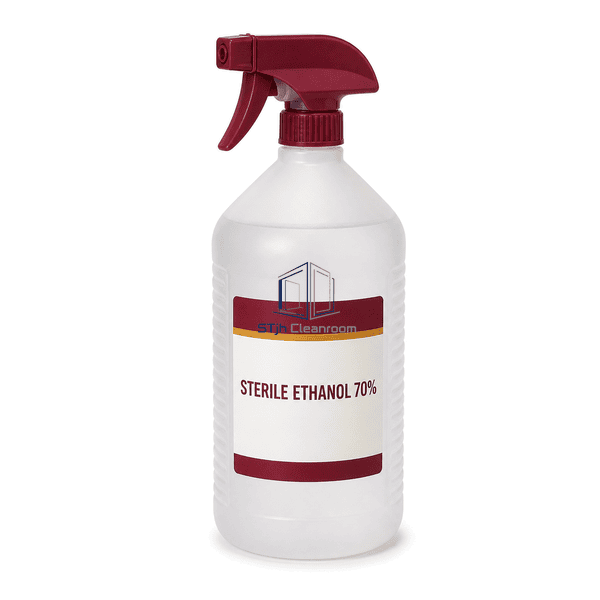
Sterile Ethanol Solution is a clear, colorless alcohol preparation based on 70% v/v ethanol or low-residue denatured ethanol and 30% WFI-quality or purified water. Oval semi-translucent HDPE trigger bottles provide a stable grip, visible fill level, and directed mist or stream application without routine dilution. The protected trigger and tamper-evident neck help maintain container integrity, while double- or triple-bagged formats allow successive outer layers to be removed at material-transfer boundaries. The solution is intended for compatible hard, nonporous surfaces and gloved hands only where the facility procedure permits. It is flammable, is not a detergent, and does not replace a validated sporicidal step.
Key Features
Water for Injection or purified-water blend options
Volatile denaturant configurations for low nonvolatile residue
Clear, colorless liquid with fast surface evaporation
0.2 or 0.22 micron filtered preparation options
Protected adjustable trigger for controlled mist or stream delivery
Tamper-evident threaded closure on a ribbed-grip HDPE bottle
Double- or triple-bagged transfer and irradiated sterile formats
Customer Product Concerns
Not every ethanol blend is appropriate for a critical environment. Nonvolatile denaturants can leave deposits, repeated decanting can disturb the prepared concentration, and an open spray bottle can admit particles or microorganisms. Alcohol vapor also accumulates if operators over-apply the liquid or work without adequate ventilation. A controlled formulation, protected closure, defined wiping technique, and staged transfer package address these risks at the point of use.
Could the denaturant leave a residue on sensitive surfaces?Low-nonvolatile-residue formulations use a volatile alcohol denaturant rather than dye, bitterant, or other persistent additives. The final selection can be aligned with the facility's residue limit and material-compatibility study.
How is dilution error avoided at the point of use?The prepared 70% v/v solution arrives ready to spray or dispense, eliminating routine operator measurement and reducing concentration variation between cleaning rounds.
What protects the liquid after the bottle enters a critical area?A tamper-evident neck and protected trigger reduce unnecessary opening and limit air return during dispensing. Bagged presentation protects the primary bottle until each defined transfer boundary is reached.
Can the spray pattern be matched to different wiping tasks?An adjustable trigger can provide a directed stream for corners or a controlled mist for broader hard surfaces. Applying to a qualified wipe can further limit airborne droplets and local vapor loading.
Does sterile ethanol cover every contamination challenge?Ethanol supports routine treatment of compatible surfaces but does not remove heavy soil and does not replace a sporicide. A separate cleaning step, chemistry rotation, ventilation, ignition control, and defined wet-contact method remain part of the facility program.
Typical Applications
Final wipe-down of compatible aseptic processing surfacesExterior cleaning of cleanroom tools and small equipmentRestricted-access barrier and isolator surface treatmentMaterial-transfer disinfection at cleanroom entry stagesControlled wiping of stainless steel and compatible polymersGloved-hand application where permitted by the approved procedurePharmaceutical and biotechnology critical support areasMedical-device and laboratory controlled environments
Technical Parameters
A 70% v/v aqueous ethanol blend combines rapid alcohol evaporation with enough water to extend wetting across a hard surface. Sterile cleanroom preparations are commonly blended with Water for Injection or high-grade purified water, filtered through a 0.2 or 0.22 micron membrane, filled into controlled primary packaging, and terminally irradiated when specified. Ethanol may be supplied undenatured or with a volatile denaturant such as isopropyl alcohol; the denaturant system must be selected for the applicable market and surface-residue requirement.
| Core Material | 70% v/v ethanol or low-residue denatured ethanol blended with 30% Water for Injection or purified water |
|---|---|
| Panel Thickness | 0.8–1.4 mm nominal wall thickness for the oval HDPE trigger bottle |
| Effective Width | 105–135 mm typical body width for a 1 L oval container |
| Maximum Length | 285–345 mm overall height including the protected trigger sprayer |
| Steel Facing Thickness | 0 mm; polymer primary packaging without steel facing |
| Core Density | 850–890 kg/m³ typical density at 20–25 °C for a 70% v/v aqueous ethanol blend |
| Thermal Conductivity | Approximately 0.22–0.32 W/(m·K) at 20 °C for the aqueous ethanol solution |
| Surface Finish | Clear, colorless liquid in a smooth semi-translucent natural HDPE bottle with molded grip ribs |
| Joint Type | Threaded tamper collar with an air-isolating trigger head or leak-resistant bulk cap |
| Customization | Available based on the intended application and operating environment. |
Available Options
500 mL protected trigger bottle1 L oval protected trigger bottle5 L tamper-evident capped HDPE containerBag-on-valve or nonpressurized spray configurationWFI-quality or purified-water blendUndenatured or volatile-denaturant ethanol formulation0.2 or 0.22 micron filtered preparationDouble- or triple-bagged material-transfer packageTerminally irradiated sterile presentation
Planning a Sterile Ethanol Solution specification?
Send us your dimensions, installation conditions, performance targets and required surface finish.