 EnglishCurrent
 德语
德语 阿拉伯语
阿拉伯语 法语
法语 印尼语
印尼语 日语
日语 韩语
韩语 马来语
马来语 葡萄牙语
葡萄牙语 俄语
俄语 西班牙语
西班牙语 泰语
泰语 土耳其语
土耳其语 越南语
越南语

Cleanroom Testing and Validation Instruments
Compressed Air Oil Content Tester
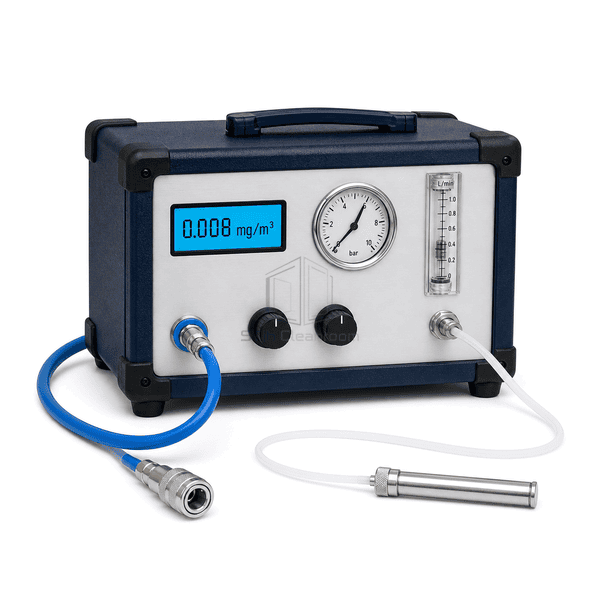
A portable case-style compressed-air oil testing platform with regulated bypass sampling, pressure and flow indication, oil-vapour measurement and dedicated connections for phase-appropriate sampling modules.
- Regulated compressed-air bypass sampling.
- Visible pressure and flow control.
- Phase-appropriate oil measurement paths.
Product Introduction
This portable tester conditions a representative side stream from a compressed-air line before it reaches the selected oil measurement path. An inlet regulator, analog pressure gauge and variable-area flowmeter establish stable sampling conditions, while stainless and PTFE wetted parts help limit hydrocarbon carryover. The integrated oil-vapour channel displays the normalized residual-oil result and supports logged spot checks after dryers, adsorbers and oil-free compressors. Liquid oil and oil aerosol require a separate coalescing-filter or sampling-disc method, so the front sampling interface accepts an appropriate holder without treating vapour and aerosol as the same measurand.
Key Features
Dedicated pressure gauge and vertical variable-area flowmeter make sample conditions visible at the instrument.
Integrated display presents the oil-vapour result and sampling status without resembling a smoke visualizer.
Short stainless and PTFE flow paths reduce adsorption, desorption and contamination from unsuitable hose materials.
Separate quick-connect inlet and sampling outlet prevent accidental reversal of the controlled flow path.
Rugged carry-case enclosure, fold-flat handle and four feet support clean transport and stable bench placement.
Customer Product Concerns
Oil-vapour and oil-aerosol results are only meaningful when the sampled phase, location, pressure, flow, duration and wetted materials are controlled, so the sampling plan must be defined before connecting the instrument.
Pressure surges or an unstable bypass flow can change response time and make sequential samples difficult to compare.Use the inlet regulator, pressure gauge and needle-valve flow control to stabilize the indicated sample conditions before recording the result.
Hydrocarbon residue in a hose or fitting can create carryover after a contaminated sampling point.Use short clean stainless/PTFE wetted paths, flush the line, cap both ends during transport and replace contaminated sample tubing or holders.
Oil vapour, liquid oil and oil aerosol require different collection and analysis methods.Select the vapour sensor or sorbent-tube path for vapour and a coalescing-filter or sampling-disc holder for aerosol, then report each phase with its applicable method.
A non-representative point or unrecorded flow and time can invalidate a sample-volume calculation.Take a representative side stream after system stabilization and record pressure, flow, duration, temperature and sampling location with the result.
Typical Applications
Oil-vapour checks downstream of activated-carbon adsorbersCommissioning of oil-free compressor and treatment trainsCleanroom process-air and instrument-air verificationPharmaceutical, food and electronics compressed-air surveysMaintenance trending before and after filter replacement
Technical Parameters
Representative construction for a portable compressed-air oil testing platform is listed below; sensor range, upstream pressure reduction, sample holder and analysis path should be selected for the expected oil phase and required reporting method.
| Core Material | PC/ABS and coated-aluminum portable enclosure with TPE corner guards, anodized-aluminum panel, stainless sampling fittings, borosilicate flow tube, PTFE sample hose and electronic oil-vapour sensor module |
|---|---|
| Panel Thickness | Typically 2.0-3.0 mm for the molded enclosure and internal mounting panel |
| Effective Width | Approximately 320-380 mm across the portable instrument case |
| Maximum Length | Approximately 400-480 mm for the complete closed case, excluding detachable hoses |
| Steel Facing Thickness | Typically 0.8-1.2 mm for the internal shield, fitting brackets and sampling-module retainers |
| Core Density | Approximately 1100-1200 kg/m³ for the PC/ABS enclosure blend |
| Thermal Conductivity | Approximately 0.19-0.22 W/(m·K) for the PC/ABS enclosure blend |
| Surface Finish | Dark-navy fine-texture case, light-gray anodized control panel, cyan port rings, black controls, clear flow tube, blue inlet hose and translucent PTFE sample line |
| Joint Type | Stainless quick-connect inlet, compression-sealed PTFE sample outlet, panel-mounted pressure regulator and needle valve, replaceable sampling holder and strain-relieved data/power ports |
| Customization | Available based on the intended application and operating environment. |
Available Options
Integrated photoionization oil-vapour measurement channelPressurized sorbent-tube holder for laboratory analysisInline coalescing-filter or sampling-disc aerosol holderHigh-pressure upstream regulator and quick-connect adapter setAlternative PTFE hose lengths and stainless sampling lanceInternal data logging, USB export and protective transport case
Planning a Compressed Air Oil Content Tester specification?
Send us your dimensions, installation conditions, performance targets and required surface finish.