 EnglishCurrent
 德语
德语 阿拉伯语
阿拉伯语 法语
法语 印尼语
印尼语 日语
日语 韩语
韩语 马来语
马来语 葡萄牙语
葡萄牙语 俄语
俄语 西班牙语
西班牙语 泰语
泰语 土耳其语
土耳其语 越南语
越南语

Cleanroom Testing and Validation Instruments
Cleanroom Noise and Vibration Test Kit
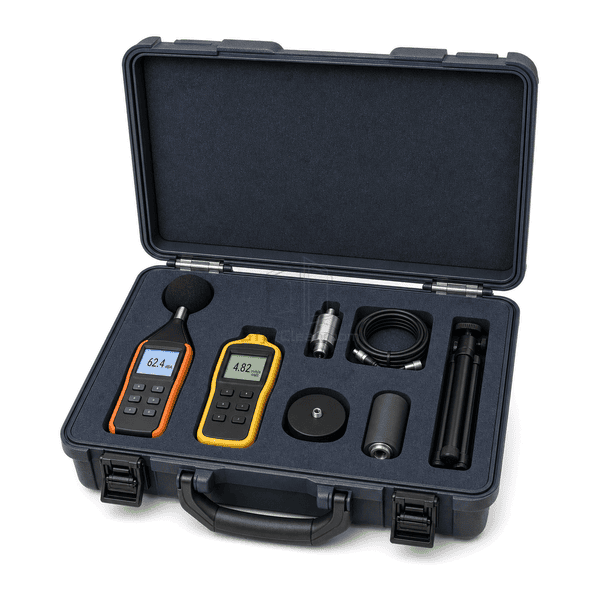
A portable cleanroom noise and vibration test kit combining an integrating sound level meter, an external-sensor vibration meter and field-check accessories for coordinated facility and equipment surveys.
- Coordinated noise and vibration surveys.
- Dedicated acoustic and accelerometer paths.
- Fitted portable measurement kit.
Product Introduction
This organized field kit keeps two separate measurement paths in one fitted case. The sound level meter supports repeatable room-background, workstation and equipment-noise surveys with an acoustic windshield, tripod positioning and before-and-after calibrator checks. The vibration meter connects to one external accelerometer that can be coupled through the supplied magnetic base or placed with the probe accessory on an identified machine or support point. Logged sound and vibration readings can then be compared with the defined locations, directions, operating conditions and project limits in the approved survey plan. The kit supports investigation and documentation; it does not automatically certify a cleanroom, process tool or building service as acceptable.
Key Features
Integrating sound level functions can capture time-weighted, frequency-weighted and equivalent continuous sound levels when the selected meter configuration supports them.
External accelerometer path supports acceleration, velocity or displacement checks with RMS, peak or peak-to-peak processing selected for the survey objective.
One acoustic calibrator and one foam windshield support field verification and stable microphone use before and after a defined measurement sequence.
One magnetic base, one coiled sensor cable and a dedicated probe or tripod slot keep the vibration contact method and acoustic positioning accessories together.
Deep gray-blue transport case with fitted foam, fixed latches and a carry handle protects the two instruments and prevents accessory-count drift during site work.
Customer Product Concerns
Useful cleanroom noise and vibration data depends on consistent locations, sensor orientation, microphone spacing, frequency and time settings, equipment load, room occupancy and HVAC state; each condition must be recorded before results are compared.
Noise readings taken at different heights or distances cannot be compared reliably.Define the microphone position and orientation in advance, use the small tripod where appropriate and repeat each reading at the same documented location and operating state.
Air turbulence from diffusers or operator movement can disturb the microphone.Fit the single foam windshield, keep the operator clear of the acoustic path and record the airflow and occupancy condition with the measurement.
A loose accelerometer or changing contact point can dominate the vibration result.Clean the selected point, use the magnetic base on a suitable ferromagnetic surface, keep the sensor axis consistent and verify that the cable is strain-relieved.
Sound and vibration values may be interpreted without the correct weighting, bandwidth or measurement quantity.Save the selected acoustic weighting and time response together with the vibration quantity, detector mode and frequency range for every survey set.
Instrument drift between the start and end of a noise survey may go unnoticed.Perform and record the defined acoustic calibrator check before and after the sound measurements, then investigate any change outside the approved tolerance.
A single high reading may be treated as an automatic cleanroom failure.Repeat the point under controlled conditions, compare it with background and equipment-state records, and apply only the acceptance limits defined by the governing test plan.
Typical Applications
Background sound surveys in at-rest and operational cleanroom areasNoise investigation around air-handling units, fan filter units and process toolsVibration checks on motors, pumps, bearings, frames and equipment support pointsBaseline measurements before and after maintenance, balancing or isolation workTroubleshooting of audible tonal noise, rattling panels and transmitted machine vibrationCoordinated facility mapping where each sound and vibration point is recorded with its operating state
Technical Parameters
The representative kit contains one integrating sound level meter, one external-sensor vibration meter and a controlled set of field accessories. Final meter class, acoustic bandwidth, vibration quantity, frequency range, sensor mounting method, calibration interval and acceptance limits should follow the intended survey procedure.
| Core Material | Impact-resistant polypropylene transport case with cross-linked PE/EVA fitted foam, PC/ABS handheld instrument housings, stainless accelerometer hardware and elastomer cable jackets |
|---|---|
| Panel Thickness | Typically 2.5-4.0 mm for the molded case walls, lid and protective handheld-meter shells |
| Effective Width | Approximately 480-600 mm across the closed portable case, depending on the selected meter and accessory arrangement |
| Maximum Length | Approximately 850-1150 mm for the open case with the complete instruments, sensor cable and positioning accessories arranged for use |
| Steel Facing Thickness | Typically 1.0-2.0 mm for stainless sensor sleeves, magnetic-base plates, calibrator fittings and reinforced accessory hardware |
| Core Density | Typically 60-90 kg/m³ for the fitted closed-cell protective foam insert |
| Thermal Conductivity | Typically 0.033-0.045 W/(m·K) for the closed-cell PE/EVA protective foam |
| Surface Finish | Textured deep gray-blue case and foam with a black-orange sound meter, black-yellow vibration meter, black windshield and cable, satin-silver accelerometer, black magnetic base and charcoal acoustic calibrator |
| Joint Type | Hinged dual-latch case with keyed foam slots; detachable vibration sensor cable to one accelerometer and magnetic base, plus a slip-fit acoustic calibrator coupler for the sound-meter microphone |
| Customization | Available based on the intended application and operating environment. |
Available Options
Class 1 or Class 2 integrating sound level meter configurations selected for the measurement planA, C and Z frequency weightings with Fast, Slow and Impulse time responses where supportedReal-time octave, one-third-octave or audio-event recording modulesVibration acceleration, velocity, displacement and FFT analysis configurationsAlternative accelerometer sensitivities, magnetic bases and probe tipsLonger low-noise sensor cables and additional mounting adaptersUSB or wireless time-history export with configurable point identifiersCleanable case inserts and accessory labels for controlled-area entry procedures
Planning a Cleanroom Noise and Vibration Test Kit specification?
Send us your dimensions, installation conditions, performance targets and required surface finish.