
 Inglés
 Alemán
 El árabe
 Francés
 Idioma indonesio
 El japonés
 Coreano
 El malayo
 El portugués
 El ruso
 EspañolCurrent
 Tailandés
 El turco
 El vietnamita

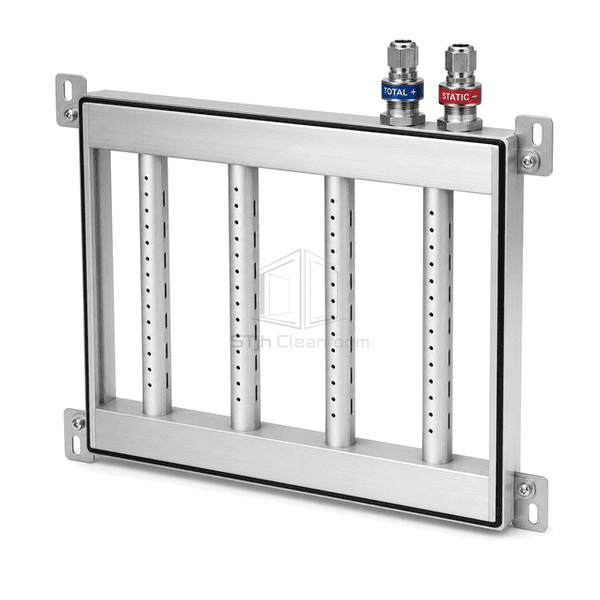
Control de salas limpias y sistemas de monitoreo ambiental
Sensor de flujo de aire
A multi-point averaging sensor that samples total and static pressure across a duct and produces a stable differential signal for air-volume calculation.
- Multi-Point Duct Averaging
- Total and Static Pressure
- Low Permanent Pressure Loss
- External Tubing Ports
Introducción del producto
The duct airflow sensor uses perforated aluminum or stainless sensing tubes positioned across the duct cross-section. Upstream ports collect total pressure and separate ports collect static pressure; each set is internally averaged before reaching the external connectors. The resulting differential pressure represents mean duct velocity more reliably than a single-point pickup. Connected to a differential transmitter or controller, the sensor supports continuous volume-flow indication, alarm or closed-loop regulation without an active electronic element in the duct.
Características clave
Separate total and static chambers provide a continuous differential pressure signal.
Passive probe construction needs no power or electronics inside the airstream.
External barbed or compression fittings simplify connection to a remote transmitter.
Preocupaciones del producto del cliente
Single-point velocity readings often misrepresent total duct airflow when profiles are uneven after elbows, dampers or transitions.
A central pitot point misses high and low velocity regions across the duct.Distributed ports average the profile across multiple locations.
Electronics in the duct are difficult to service and expose wiring to airflow.The passive sensing grid sends only pneumatic signals to an external transmitter.
Tubing connections are inaccessible after ceiling closure.External manifolds place total and static fittings at a serviceable duct location.
Incorrect duct dimensions produce an inaccurate volume-flow value.The controller uses the actual duct area and measured differential to calculate airflow.
Aplicaciones típicas
AHU supply airflow measurementCleanroom main-duct monitoringReturn-air volume trackingExhaust airflow control
Parámetros técnicos
Typical construction for a cleanroom duct averaging airflow sensor is listed below.
| Materiales Core | 6063 anodized aluminum sensing tubes with galvanized steel or stainless mounting frame |
|---|---|
| Panel de espesor | 25-60 mm sensing-tube depth |
| Ancho efectivo | 200-1500 mm duct span |
| Longitud máxima | Up to 1800 mm sensing-grid length |
| Acero frente a espesor | 1.2-1.6 mm galvanized or stainless mounting frame |
| Densidad Core | 2650-2750 kg/m³ for aluminum sensing elements |
| Conductividad térmica | 150-220 W/(m·K) for aluminum sensing tubes |
| Superficie acabada | Natural anodized aluminum tubes with clean zinc-coated or satin stainless frame |
| Tipo conjunto | Duct flange or insertion brackets with separated total-static pressure connectors |
| Customization | Disponible según la aplicación prevista y el entorno operativo. |
Opciones disponibles
Cross-grid or single-span probeAluminum or stainless constructionCircular or rectangular duct fitBarbed or compression fittings
Planning a Airflow Sensor specification?
Envíenos sus dimensiones, condiciones de instalación, objetivos de rendimiento y acabado superficial requerido.