
 Anglais
 Allemand
 Arabe
Arabe FrançaisCurrent
 Indonésien
 Japonais
 Coréen
 Le malais
 Le portugais
 russe
russe espagnol
 Thaïlandais
 Le turc
 Le vietnamien

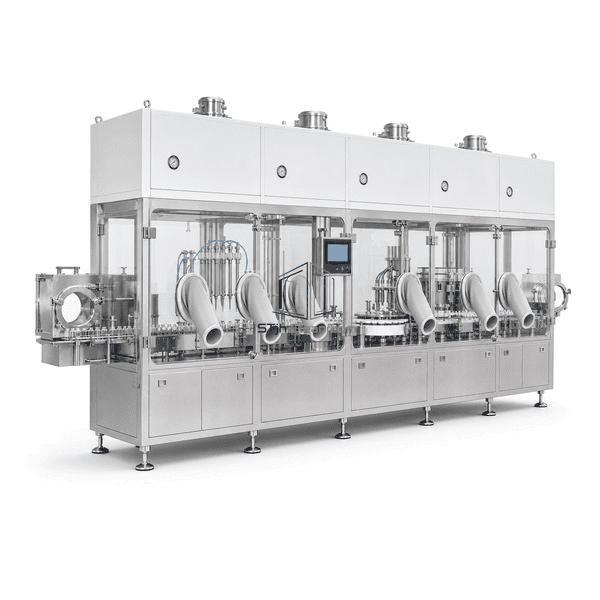
Équipement d'écoulement et de confinement laminaires
Isoleur de remplissage aseptique par
A custom barrier enclosure integrated around filling, stoppering and closure equipment to protect open sterile containers throughout the critical process.
- Filling-Line Integration
- Critical-Zone Unidirectional Air
- Glove-Assisted Intervention
- Closed Component Transfer
Introduction de produit
The aseptic filling isolator is designed around the exact fill-finish equipment rather than supplied as an empty cabinet. Chamber sections enclose container infeed, filling, stoppering and critical closure steps, with HEPA-filtered unidirectional air directed over open containers. Glove ports permit planned interventions, while rapid transfer ports, transfer hatches or sterile connectors introduce components. Removable or lift-up lower sections preserve access to the filling machine for controlled maintenance.
Key Features
Dedicated diffuser zones maintain first air above critical filling and stoppering points.
Glove ports are positioned for defined interventions rather than general access.
Closed transfer interfaces introduce stoppers, tools and components.
Technical-side panels allow machine service without dismantling the complete barrier.
Préoccupations du client produit
The isolator must fit the filling machine while preserving first air, intervention reach and maintenance access along the complete container path.
Machine frames block clean air above open containers.Diffuser modules are divided around the actual fill and stopper positions.
Glove ports do not reach jam-clearance points.Intervention mapping sets glove locations before chamber fabrication.
Components enter through an open door during production.Rapid ports and sterile transfer interfaces feed closures and tools through closed paths.
Maintenance requires complete barrier removal.Sectioned technical panels and lift-up lower skirts expose the machine in a controlled shutdown.
Les applications typiques
Vial filling and stopperingPrefilled syringe fillingCartridge fillingSmall-batch sterile fill-finish
Paramètres techniques
Typical configurable construction ranges for an aseptic filling isolator are listed below.
| Matériaux de base | Welded SUS316L barrier chamber with laminated safety glass and CSM glove assemblies around filling equipment |
|---|---|
| Panneau épaisseur | 50-120 mm chamber, plenum and service sections |
| Largeur effective | 1800-6000 mm protected line width |
| Longueur maximale | Up to 20000 mm integrated filling-line length |
| Acier face épaisseur | 2.0-3.0 mm SUS316L chamber shell; 1.2-1.5 mm removable service skins |
| Densité Core | Approximately 8000 kg/m³ for SUS316L chamber material |
| Conductivité thermique | 14 - 16 W / (m · K) pour l'acier inoxydable austénitique par |
| surface finie | Electropolished SUS316L interior with flush glazed panels and radiused transitions |
| Type joint | Welded modular barrier sections with sealed machine interfaces, glove rings and rapid transfer ports |
| Customisation | Disponible en fonction de l'application prévue et de l'environnement d'exploitation. |
Options disponibles
Vial, syringe or cartridge line integrationIntegrated vapor bio-decontaminationRapid transfer and component portsGlove integrity and environmental monitoring connections
Planning a Aseptic Filling Isolator specification?
Envoyez-nous vos dimensions, conditions d'installation, objectifs de performance et finition de surface requise.