
 Englisch
 DeutschCurrent
 Arabisch
 Französisch
 indonesisch
 Japanisch
 Koreanisch
 Malaiisch
 Portugiesisch
 Russisch
 Spanisch
 Thailändisch
 Türkischer Sprache
 Vietnamesisch

Branchenspezifische Reinraumausrüstung
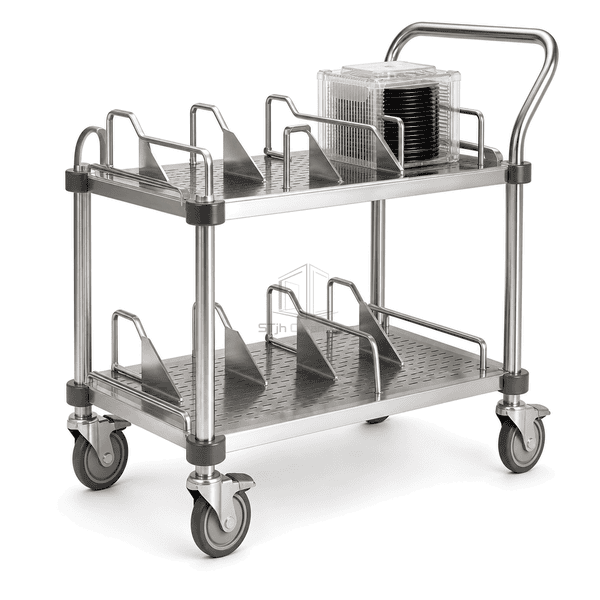
Wafer Transfer Cart
A cleanable stainless steel cart that supports wafer boxes on retained, airflow-friendly shelves during low-vibration movement through controlled areas.
- Secure Wafer-Box Retention
- Low-Shedding Stainless Frame
- Airflow-Friendly Shelves
- Smooth Locking Casters
Produkteinführung
The wafer transfer cart uses rounded stainless tubing, perforated or angled shelves and position-retaining rails to protect wafer boxes during manual movement. Smooth exposed surfaces reduce particle traps and simplify wiping, while large polyurethane casters absorb small floor irregularities that could disturb fragile wafer loads. Shelf spacing and retaining geometry can be matched to common 150 mm, 200 mm or 300 mm lot-box formats.
Key Features
Perforated shelves preserve vertical cleanroom airflow and reduce horizontal particle-collection surfaces.
Rounded stainless frame members minimize corners and exposed crevices during cleaning.
Large locking polyurethane casters provide smooth rolling and secure parking at transfer stations.
Kunden Produktbedenken
Manual wafer transport must limit vibration, prevent box movement and remain easy to clean without obstructing cleanroom airflow.
Wafer boxes can slide on a flat trolley during turning or braking.Angled shelves, dividers and retaining rails constrain each carrier position.
Small hard casters transmit floor joints directly to fragile wafer loads.Larger polyurethane wheels improve rolling smoothness and reduce shock transmission.
Box-section frames and solid shelves create difficult-to-clean particle traps.Rounded tubing and perforated shelf surfaces reduce ledges and hidden corners.
An unlocked cart can move while operators transfer a wafer box.Positive caster brakes secure the cart at loading and process-interface points.
Typische Anwendungen
Wafer lot transport between process areasMetrology and inspection stagingSemiconductor cleanroom material movementControlled transfer of closed wafer boxes
Technische Parameter
Typical construction values for a stainless cleanroom wafer transfer cart are shown below.
| Core Material | 304 or 316L stainless steel tubular frame with stainless perforated shelves |
|---|---|
| Panel Dicke | 1.0-1.5 mm shelf sheet thickness |
| Effektive Breite | 750-1450 mm cart width |
| Maximale Länge | Up to 1600 mm cart length |
| Stahl facing Dicke | 1.0-1.5 mm stainless steel shelves and retaining panels |
| Kerndichte | 7850-8000 kg/m³ for stainless steel components |
| Thermische Leitfähigkeit | 14-17 W/(m·K) for stainless steel structure |
| Oberfläche Finish | Brushed or electropolished stainless steel with smooth deburred edges |
| Gemeinsamer Typ | Continuous welded tubular frame with removable shelf dividers and locking caster plates |
| Customisierung | Verfügbar je nach beabsichtigter Anwendung und Betriebsumgebung. |
Verfügbare Optionen
150 mm, 200 mm or 300 mm box layoutAngled or level perforated shelves304 or 316L stainless steelCustom shelf and retaining-rail arrangement
Planning a Wafer Transfer Cart specification?
Senden Sie uns Ihre Abmessungen, Installationsbedingungen, Leistungsziele und gewünschte Oberflächenveredelung.