
 Englisch
 DeutschCurrent
 Arabisch
 Französisch
 indonesisch
 Japanisch
 Koreanisch
 Malaiisch
 Portugiesisch
 Russisch
 Spanisch
 Thailändisch
 Türkischer Sprache
 Vietnamesisch

Reinraumreinigung, Desinfektion und Sterilisation
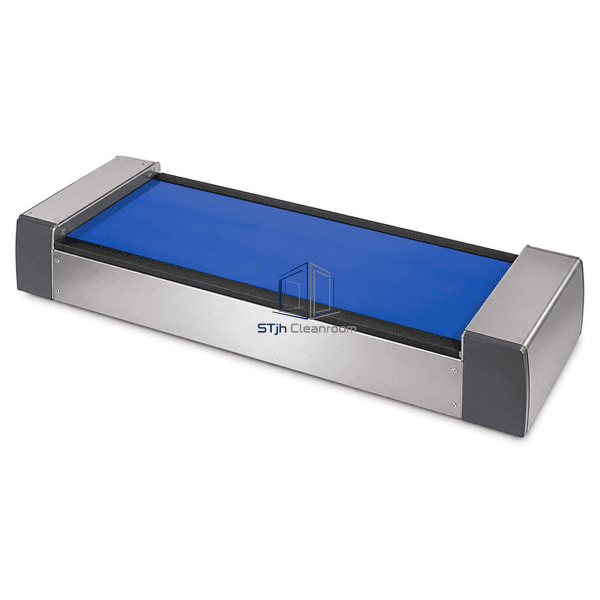
Schuh Sole Tacky Roller
Walk-over shoe-sole tacky roller station that presents a continuously refreshed adhesive film for capturing footwear particles at controlled-area entrances.
- Walk-over particle capture at entry points
- Enclosed take-up protects used adhesive
- Replaceable continuous tacky-film cartridge
Produkteinführung
The Shoe Sole Tacky Roller is a low-profile stainless station with a supported adhesive film across the walking surface. Each pass presses shoe soles against the tacky layer to collect dry dust and fibers; an indexed roller mechanism advances used film into the enclosed housing and exposes a fresh section. A stable non-slip frame and shallow step height support routine personnel flow without loose peel-off sheets around the entrance.
Key Features
Indexed film advance maintains a usable tack surface.
Used film winds into a closed compartment.
Low step height supports natural walking movement.
Stainless outer housing is easy to wipe down.
Cartridge design simplifies consumable replacement.
Kunden Produktbedenken
The station addresses inconsistent sticky-mat replacement, exposed loaded sheets, variable footwear contact and entrance congestion.
Overused adhesive surfacesIndexed advance exposes fresh tack at defined intervals.
Contaminated sheet disposalLoaded film winds into an enclosed take-up roll.
Incomplete sole contactThe supported broad surface allows a normal step across the adhesive zone.
schwierige SanitärBrushed stainless exterior panels tolerate routine wipe-down.
Typische Anwendungen
Cleanroom gowning-room entrancesPersonal-AirlocksElectronics assembly access pointsPharmaceutical support corridorsControlled packaging areas
Technische Parameter
The following values describe compact automatic adhesive-film sole cleaners for gowning rooms, airlocks and controlled production entries.
| Core Material | Low-density polyethylene adhesive film on polymer roller cores |
|---|---|
| Panel Dicke | 2.0 mm stainless top-panel thickness |
| Effektive Breite | 500-700 mm walking width |
| Maximale Länge | 1200 mm overall station length |
| Stahl facing Dicke | 1.5-2.0 mm Type 304 stainless enclosure thickness |
| Kerndichte | 920 kg/m³ nominal polyethylene film density |
| Thermische Leitfähigkeit | 0.33 W/(m·K) nominal for polyethylene film |
| Oberfläche Finish | Brushed stainless housing with blue pressure-sensitive film |
| Gemeinsamer Typ | Indexed supply-and-take-up roller cartridge within hinged enclosure |
| Customisierung | Verfügbar je nach beabsichtigter Anwendung und Betriebsumgebung. |
Verfügbare Optionen
Manual pedal or automatic indexed advance500, 600 or 700 mm walking widthBlue, white or transparent tacky filmFreestanding or recessed installationEntry counter and film-use indicator
Planning a Shoe Sole Tacky Roller specification?
Senden Sie uns Ihre Abmessungen, Installationsbedingungen, Leistungsziele und gewünschte Oberflächenveredelung.