
 Inglés
 Alemán
 El árabe
 Francés
 Idioma indonesio
 El japonés
 Coreano
 El malayo
 El portugués
 El ruso
 EspañolCurrent
 Tailandés
 El turco
 El vietnamita

Control de salas limpias y sistemas de monitoreo ambiental
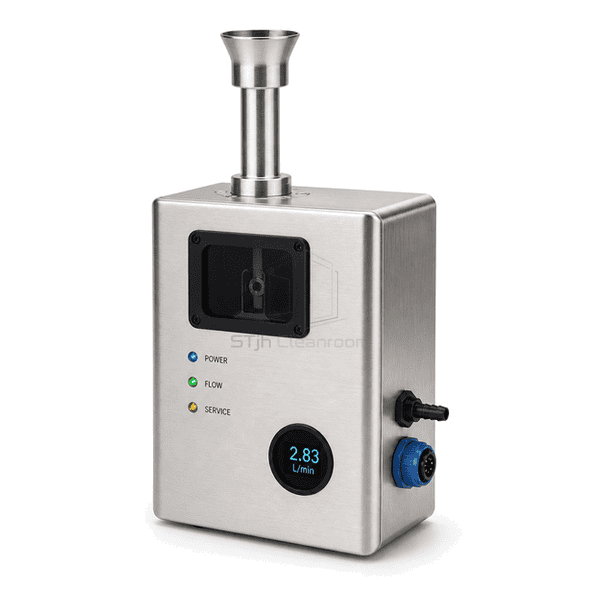
Sensor remoto de partículas aéreas
A fixed-location optical particle sensor that continuously counts airborne particles at a cleanroom sample point and sends channel data to the monitoring system.
- Continuous Particle Counting
- Multiple Size Channels
- Remote Vacuum Sampling
- Digital Monitoring Output
Introducción del producto
The remote airborne particle sensor draws a controlled sample through an isokinetic probe and laser scattering chamber. Individual particles interrupt the laser beam and are classified by signal amplitude into configured size channels. The compact stainless or coated housing mounts near the sample point while vacuum, power and communication remain accessible from the service side. Continuous counts and sensor-health status are transferred to the environmental monitoring platform for real-time display, alarming and historical review.
Características clave
A remote isokinetic probe presents the inlet correctly to the cleanroom airflow direction.
External vacuum or integrated pumping options support continuous fixed-point sampling.
Digital output carries particle channels, flow status and instrument alarms together.
Preocupaciones del producto del cliente
Continuous particle monitoring depends on representative sampling, stable flow and prompt detection of blocked tubing or vacuum loss.
A poorly oriented inlet under-samples larger particles moving with the room airflow.An isokinetic probe aligns the sample opening with the local cleanroom flow direction.
Long tubing allows particle loss before the sample reaches the sensor.Mounting the sensor close to the probe shortens the particle path and reduces deposition.
Vacuum loss produces zero counts that look like clean air.Flow and vacuum diagnostics create a separate instrument alarm rather than reporting a false normal result.
Service activity exposes the room side to open wiring and tubing.Service-side connections and a clean stainless or coated enclosure preserve the cleanroom face.
Aplicaciones típicas
Aseptic filling zonesPharmaceutical cleanroomsSemiconductor mini-environmentsContinuous critical-point monitoring
Parámetros técnicos
Typical construction values for a fixed remote cleanroom particle sensor are listed below.
| Materiales Core | Optical glass laser chamber in anodized aluminum frame with stainless steel or coated enclosure |
|---|---|
| Panel de espesor | 80-140 mm sensor depth |
| Ancho efectivo | 100-180 mm housing width |
| Longitud máxima | Up to 300 mm enclosure length |
| Acero frente a espesor | 0.8-1.2 mm stainless or coated steel housing |
| Densidad Core | 2650-8030 kg/m³ across aluminum frame and stainless enclosure parts |
| Conductividad térmica | 14-220 W/(m·K) across stainless and aluminum structural components |
| Superficie acabada | Brushed stainless steel or smooth white coated housing with blue status LED |
| Tipo conjunto | Isokinetic sample inlet, barbed vacuum outlet and sealed power-data connectors |
| Customization | Disponible según la aplicación prevista y el entorno operativo. |
Opciones disponibles
Two or multiple particle channelsExternal or integrated vacuumStainless isokinetic probeEthernet or serial communication
Planning a Remote Airborne Particle Sensor specification?
Envíenos sus dimensiones, condiciones de instalación, objetivos de rendimiento y acabado superficial requerido.