
 Inglés
 Alemán
 El árabe
 Francés
 Idioma indonesio
 El japonés
 Coreano
 El malayo
 El portugués
 El ruso
 EspañolCurrent
 Tailandés
 El turco
 El vietnamita

Sistemas de distribución de aire para salas limpias
Aislador de Vibración Duct
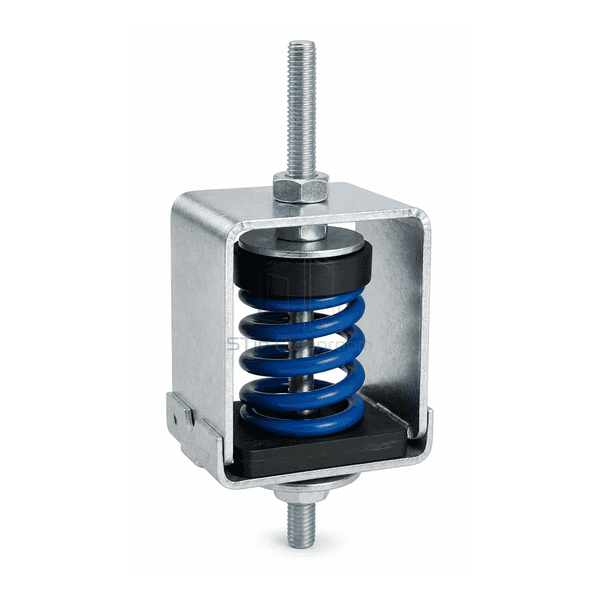
A spring-and-neoprene hanger that interrupts the rigid load path between suspended ductwork or inline fans and the building structure.
- Low-Frequency Steel Coil Spring
- Neoprene High-Frequency Isolation
- Zinc-Plated Hanger Housing
- Threaded-Rod Misalignment Protection
Introducción del producto
The duct vibration isolator is installed in the threaded-rod suspension path supporting ductwork, inline fans or a trapeze frame. A laterally stable steel coil spring carries the vertical load, while a molded neoprene element and lower spring cup attenuate higher-frequency vibration and prevent the rod from contacting the steel housing. The open hanger frame permits visual confirmation of spring compression after loading. Oversized rod openings accommodate limited angular misalignment so the isolator can deflect freely without creating a metal-to-metal short circuit.
Características clave
A molded neoprene element in series with the spring reduces high-frequency fan and blade-passage transmission.
The open zinc-plated housing allows installers to inspect spring alignment and verify that the coil remains free of the frame.
Oversized rod passages and resilient collars tolerate practical suspension-rod offset without metal contact.
Preocupaciones del producto del cliente
Effective isolation depends on matching each hanger to its actual supported load, preserving free spring movement and preventing the threaded rod from touching the steel housing.
A spring selected for too much load becomes coil-bound and transmits vibration directly into the ceiling.The supported weight is divided by the actual hanger count so every spring operates within its rated load and deflection range.
An oversized spring barely compresses and provides little low-frequency isolation.A load-matched color-coded coil reaches the intended static deflection under normal operating weight.
A misaligned threaded rod rubs the hanger frame and bypasses the resilient elements.An oversized opening and neoprene collar keep the rod separated from the steel bracket through limited angular offset.
Unequal hanger loading twists the duct trapeze and overloads one corner.Level support geometry and individually selected spring capacities distribute the suspended weight across all isolation points.
Aplicaciones típicas
Suspended cleanroom supply and exhaust ductsInline duct fan supportsFan-coil and terminal-unit hangersLaboratory exhaust duct trapezesMechanical-room piping and duct suspension
Parámetros técnicos
Representative construction ranges for a spring-and-neoprene duct vibration isolation hanger are listed below.
| Materiales Core | Laterally stable steel coil spring in series with molded neoprene cap and collar |
|---|---|
| Panel de espesor | 1.5–2.5 mm stamped and welded steel hanger housing |
| Ancho efectivo | 50–100 mm clear housing width for suspended threaded-rod alignment |
| Longitud máxima | 150–300 mm overall hanger height depending on spring deflection and load range |
| Acero frente a espesor | 1.5–2.5 mm zinc-plated steel bracket and load plate |
| Densidad Core | Approximately 7850 kg/m³ for the load-bearing spring steel |
| Conductividad térmica | Approximately 45–50 W/(m·K) through the hardened steel coil spring |
| Superficie acabada | Zinc-plated or powder-coated steel housing with color-coded spring and black neoprene elements |
| Tipo conjunto | Threaded-rod suspension through an open steel bracket, steel coil spring and neoprene load-distribution cup |
| Customization | Disponible según la aplicación prevista y el entorno operativo. |
Opciones disponibles
13 mm or 25 mm nominal spring deflectionLight-duty and heavy-duty load rangesSpring with neoprene or fiberglass high-frequency elementPreloaded or seismic-restraint hanger housing
Planning a Duct Vibration Isolator specification?
Envíenos sus dimensiones, condiciones de instalación, objetivos de rendimiento y acabado superficial requerido.