
 ภาษาอังกฤษ
 ภาษาเยอรมัน
 ภาษาอาหรับ
 ฝรั่งเศส
 ภาษาอินโดนีเซีย
 ภาษาญี่ปุ่น
 ภาษาเกาหลี
 ภาษามาเลย์
 ภาษาโปรตุเกส
 ภาษารัสเซีย
 ภาษาสเปน
 ภาษาไทยปัจจุบัน
 ภาษาตุรกี
 ภาษาเวียดนาม

ระบบควบคุมห้องคลีนรูมและระบบตรวจสอบสิ่งแวดล้อม
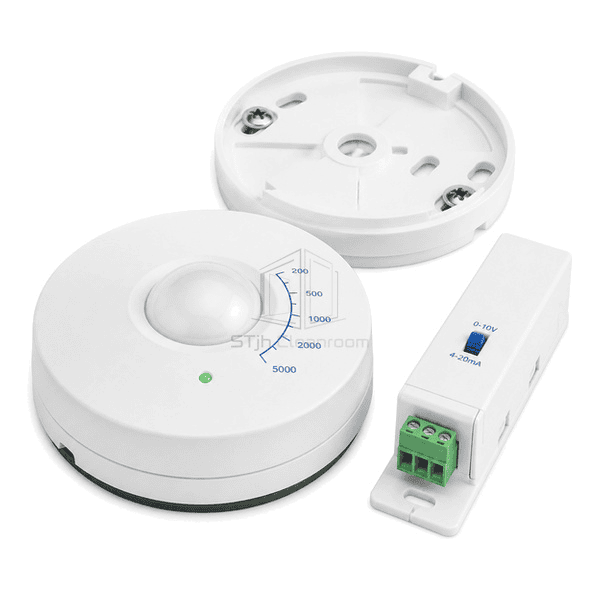
เซ็นเซอร์ส่องสว่าง
A ceiling or wall-mounted lux sensor that measures incident light for cleanroom illumination monitoring and dimming control.
- Cosine-Corrected Lux Measurement
- Low-Profile Optical Head
- 0-10 V or 4-20 mA Lux Signal
- Lighting Control Integration
การแนะนําสินค้า
The cleanroom illuminance sensor uses a photodiode and optical diffuser to measure light arriving from a broad field of view. Cosine correction helps the response represent incident illuminance rather than only light perpendicular to the sensor. Range selection covers typical task-lighting and bright inspection environments. A standard analog or digital output supports light-level monitoring, daylight-responsive dimming and alarm reporting while the smooth white housing blends with clean ceilings.
คุณสมบัติที่สําคัญ
Selectable lux ranges preserve resolution in both normal work and high-illumination areas.
Low-profile white construction minimizes visual disruption on clean ceilings.
Analog and network outputs connect to lighting controls and environmental monitoring.
ความกังวลของลูกค้าเกี่ยวกับผลิตภัณฑ์
Illuminance depends on sensor orientation, shadows and surface reflections, so the measurement point must represent the actual working plane.
A sensor directly under one luminaire overstates the room's average light level.Representative placement and broad optical response reduce local hotspot bias.
Oblique light is under-read by a narrow-angle detector.A cosine-corrected diffuser captures light over a wider incidence angle.
One measurement range saturates in high-intensity inspection zones.Selectable lux ranges match the sensor to ambient or task-light applications.
Dimming causes visible hunting around the target level.Control deadband and time filtering prevent rapid response to small light fluctuations.
การใช้งานทั่วไป
Cleanroom task-light monitoringInspection-area illuminationDaylight-responsive dimmingLaboratory lighting verification
พารามิเตอร์ทางเทคนิค
Typical construction values for a cleanroom ceiling illuminance sensor are listed below.
| วัสดุหลัก | Silicon photodiode with optical diffuser in UV-stable polycarbonate housing |
|---|---|
| ความหนาของแผง | 25-45 mm sensor depth |
| ความกว้างที่มีประสิทธิภาพ | 70-110 mm housing diameter |
| ความยาวสูงสุด | Up to 130 mm overall housing dimension |
| ความหนาของเหล็กหันหน้า | 0 mm; non-metallic optical enclosure |
| ความหนาแน่นหลัก | 1180-1220 kg/m³ for polycarbonate housing material |
| การนําความร้อน | 0.19-0.22 W/(m·K) for polycarbonate enclosure |
| เสร็จสิ้นพื้นผิว | Matte white body with opal optical dome and discreet blue range mark |
| ประเภทร่วม | Twist-lock ceiling base or wall plate with rear pluggable signal terminals |
| การปรับแต่ง | สามารถใช้ได้ตามแอปพลิเคชันที่ตั้งใจไว้และสภาพแวดล้อมการทํางาน |
ตัวเลือกที่มีอยู่
Multiple lux rangesCeiling or wall mountingVoltage or 4-20 mA outputModbus or BACnet communication
Planning a Illuminance Sensor specification?
ส่งมิติของคุณเงื่อนไขการติดตั้งเป้าหมายประสิทธิภาพและผิวที่ต้องการ