
 日本語
日本語 ドイツ人。
ドイツ人。 アラビア語:アラビア語
 フランス語で
 インドネシア語
 日本語で。流れ
 韓国語
韓国語 マレー語
マレー語 ポルトガル語
 ロシア語
ロシア語 スペイン語
スペイン語 タイ語
タイ語 トルコ語
トルコ語 ベトナム語
ベトナム語

クリーンルームのドア、窓およびインターロックシステム
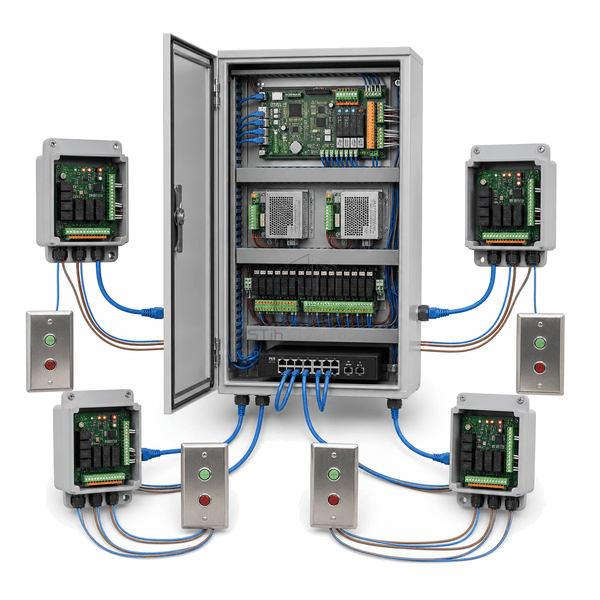
ネットワーク化されたマルチドアのクリーンルームのインターロックシステム
A scalable interlock architecture that connects multiple local door modules to coordinate airlocks, controlled corridors and transfer zones from one configurable supervisory system.
- Distributed Door Modules
- Scalable Interlock Zones
- Central Status Supervision
- Facility-System Interfaces
商品紹介
The networked multi-door system separates local door control from facility-level supervision. Door modules near each airlock collect position, request and lock signals, while a central controller coordinates interlock groups and communicates status to authorized operators. This architecture reduces long individual cable runs and allows zones to be expanded or reconfigured without replacing every field device. It is intended for facilities with several interconnected airlocks rather than a single two- or three-door vestibule.
主要な特徴
Configurable zones define which doors are mutually exclusive without hardwiring every relationship.
Central supervision displays door state, held-open alarms and controller communication faults.
Dry-contact or standard network interfaces exchange selected status with access control, fire alarm, BMS or SCADA systems.
お客様の製品に関する懸念事項
Large interlock schemes must remain understandable and serviceable as door counts increase, while a network fault must not produce uncontrolled door behavior.
Home-running every sensor and lock to one cabinet creates excessive cable length and difficult fault tracing.Distributed local modules collect each zone's field wiring and send coordinated status over a defined network link.
Adding a new cleanroom changes interlock relationships across several existing doors.Configurable door groups can be revised without rebuilding the complete relay architecture.
Operators cannot identify which distant door is holding an entire route locked.Central status supervision identifies the active, open or faulted channel by door name and zone.
A communication failure could leave the release state ambiguous.Local modules use a defined fail-state and retain essential door logic when supervisory communication is unavailable.
典型的な用途
Large pharmaceutical cleanroom suitesMulti-room laboratory facilitiesHospital sterile departmentsSemiconductor controlled-access networks
技術的なパラメータ
Representative physical and interface ranges for a distributed multi-door interlock platform are listed below.
| コア材料 | Central supervisory controller, distributed door I/O modules, regulated supplies, relays and network interfaces |
|---|---|
| パネルの厚さ | 100–200 mm central cabinet depth; 60–120 mm local module depth |
| 有効幅 | 300–600 mm central cabinet width |
| 最大長さ | 800 mm central cabinet height |
| 鋼鉄の厚さを直面する | 1.2–1.5 mm powder-coated steel cabinet; stainless local stations typically 1.2–2.0 mm |
| コア密度 | Approximately 1800–1920 kg/m³ for the controller and distributed-I/O PCB laminates |
| 熱伝導率 | Approximately 0.4–0.7 W/(m·K) for the PCB laminates used in the networked modules |
| 表面仕上げ | Powder-coated central cabinet, sealed local modules and brushed stainless operator plates |
| ジョイントタイプ | Networked distributed I/O with local lock/contact terminals, supervised communications and isolated auxiliary interfaces |
| カスタマイズ | 目的のアプリケーションおよび動作環境に基づいて利用可能 |
利用可能なオプション
Four-door to facility-wide channel countsEthernet or fieldbus communicationTouchscreen or web-based status displayAccess-control, fire-alarm, BMS and SCADA integration
Planning a Networked Multi-Door Cleanroom Interlock System specification?
寸法、設置条件、性能目標、必要な表面仕上げをお送りください。