
 Englisch
 DeutschCurrent
 Arabisch
 Französisch
 indonesisch
 Japanisch
 Koreanisch
 Malaiisch
 Portugiesisch
 Russisch
 Spanisch
 Thailändisch
 Türkischer Sprache
 Vietnamesisch

Cleanroom Luftverteilungssysteme
Instrument Test Port für Luftkanal
A compact sealed probe access point for repeatable pressure, temperature and airflow measurements without drilling new holes in the duct wall.
- Reusable Probe Access
- Threaded Sealing Plug
- Low-Profile Duct Fitting
- Stainless Hygienic Body
Produkteinführung
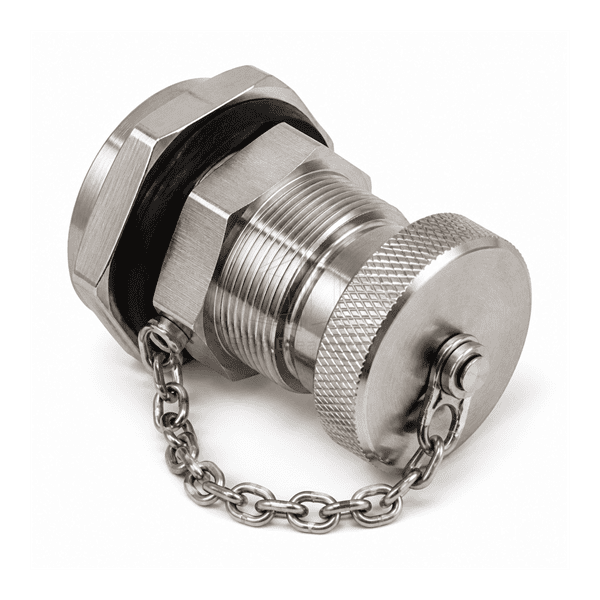
The instrument test port is a small stainless fitting installed through the duct wall at a defined measurement location. A threaded cap or tethered plug closes the opening between readings, while an elastomer grommet can seal around temporary probes. The flanged base spreads the load across thin sheet metal and is sealed to the external surface. Reusable ports prevent repeated drilling and foil-tape repairs during commissioning, filter checks and routine balancing.
Key Features
The short smooth bore accepts pitot, pressure, temperature and air-quality probes.
A broad external flange stabilizes the fitting on thin rectangular or round duct walls.
Stainless construction tolerates repeated handling and cleanroom wipe-down chemicals.
Kunden Produktbedenken
Measurement access must be repeatable and sealed so that routine testing does not leave open holes or adhesive patches in the air path.
Each balancing visit drills another hole through the duct wall.A permanent reusable port provides a single controlled probe location.
Foil tape lifts from a temporary hole and creates unnoticed leakage.A threaded cap and retained gasket form a mechanical closure between tests.
A probe scrapes a sharp raw sheet-metal edge.The smooth port bore protects instrument stems and operator hands.
Small fittings loosen when inserted through thin duct sheet.A wide flange and locked backing nut distribute load and resist rotation.
Typische Anwendungen
Differential-pressure measurementTemperature and humidity samplingPitot-tube airflow traversesFilter pressure checksCommissioning and periodic balancing
Technische Parameter
Typical dimensions and material data for a reusable stainless duct instrument port are listed below.
| Core Material | 304 stainless steel body with silicone or EPDM sealing element |
|---|---|
| Panel Dicke | 1.0–2.0 mm flange and body wall |
| Effektive Breite | 8–16 mm clear probe opening |
| Maximale Länge | 50–100 mm installed stem length |
| Stahl facing Dicke | 1.0–2.0 mm stainless steel fitting wall |
| Kerndichte | Approximately 7900–8000 kg/m³ stainless steel body |
| Thermische Leitfähigkeit | Approximately 14–16 W/(m·K) for 304 stainless steel |
| Oberfläche Finish | Smooth passivated or brushed stainless steel with color-coded plug option |
| Gemeinsamer Typ | Threaded plug in flanged bulkhead body with backing nut and perimeter seal |
| Customisierung | Verfügbar je nach beabsichtigter Anwendung und Betriebsumgebung. |
Verfügbare Optionen
8, 10, 12 or 16 mm probe boreThreaded cap or tethered silicone plugColor-coded pressure-side identificationExtended stem for insulated duct walls
Planning a Instrument Test Port for Air Duct specification?
Senden Sie uns Ihre Abmessungen, Installationsbedingungen, Leistungsziele und gewünschte Oberflächenveredelung.