
 Englisch
 DeutschCurrent
 Arabisch
 Französisch
 indonesisch
 Japanisch
 Koreanisch
 Malaiisch
 Portugiesisch
 Russisch
 Spanisch
 Thailändisch
 Türkischer Sprache
 Vietnamesisch

Reinraumbekleidung, PPE und Verbrauchsmaterialien
Cleanroom Boot Abdeckungen
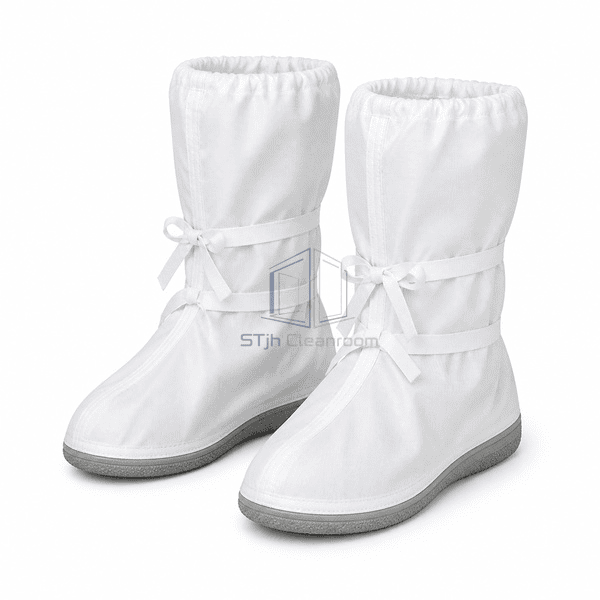
White mid-calf cleanroom boot covers with covered elastic tops, ankle ties, bound seams and gray slip-resistant soles.
- White low-lint fabric extends to mid-calf
- Covered shin elastic and ankle ties stabilize fit
- Gray slip-resistant sole supports controlled walking
Produkteinführung
Cleanroom Boot Covers provide higher leg coverage than ordinary overshoes for controlled gowning transitions. The white low-lint body encloses the footwear and lower leg, while a covered elastic top and two ankle ties help prevent sagging. A gray slip-resistant sole gives the boot cover a defined walking surface and bound seams keep construction edges contained.
Key Features
Covered shin elastic retains the upper edge without exposed rubber
Two ankle ties secure excess volume around different footwear shapes
Gray textured sole provides a visible traction surface
Bound seams reduce exposed construction edges
Kunden Produktbedenken
Boot covers must remain upright, secure and correctly oriented through gowning and movement. Loose uppers or poorly positioned ties can drag, while an unsuitable sole can reduce stability.
The upper section may slide down during walking.Use a covered elastic shin opening sized to retain the calf.
Excess material can bunch around the ankle.Secure the two ankle ties after positioning the footwear fully inside.
Ties may contact the floor during donning.Follow a controlled donning sequence that keeps tie ends elevated.
A smooth sole may be unsuitable for polished surfaces.Select a dedicated textured slip-resistant sole for the floor condition.
Typische Anwendungen
Used in pharmaceutical and biotechnology cleanrooms, medical-device manufacturing, laboratories, controlled filling areas and clean processing zones requiring extended footwear coverage.
Technische Parameter
These ranges describe common disposable mid-calf cleanroom boot covers. Sterile presentation and sole material should be selected for the actual gowning protocol and floor.
| Core Material | Low-lint polyethylene or SMS polypropylene barrier fabric |
|---|---|
| Panel Dicke | 0.20–0.30 mm body material |
| Effektive Breite | 300–380 mm calf circumference by size |
| Maximale Länge | 460 mm boot height |
| Stahl facing Dicke | 0 mm; no steel facing used |
| Kerndichte | 40–55 kg/m³ areal-mass equivalent structure |
| Thermische Leitfähigkeit | 0.04–0.07 W/(m·K), laminate dependent |
| Oberfläche Finish | White low-lint body with gray textured slip-resistant sole |
| Gemeinsamer Typ | Bound body seams, covered shin elastic and twin ankle ties |
| Customisierung | Verfügbar je nach beabsichtigter Anwendung und Betriebsumgebung. |
Verfügbare Optionen
Small through extra-large sizes16-inch or 18-inch heightGray gripper or PVC soleElastic ankle or twin tie retentionSterile paired or non-sterile bulk presentationClean-processed double-bag packaging
Planning a Cleanroom Boot Covers specification?
Senden Sie uns Ihre Abmessungen, Installationsbedingungen, Leistungsziele und gewünschte Oberflächenveredelung.