
 Inglés
 Alemán
 El árabe
 Francés
 Idioma indonesio
 El japonés
 Coreano
 El malayo
 El portugués
 El ruso
 EspañolCurrent
 Tailandés
 El turco
 El vietnamita

Limpieza de sala limpia, desinfección y esterilización
Desinfectantes esporicidas
A ready-to-use hydrogen peroxide and peracetic acid sporicidal disinfectant for controlled treatment of compatible cleanroom hard surfaces.
- Oxidizing chemistry extends contamination control beyond routine bactericidal disinfectants to bacterial and fungal spores
- Ready-to-use preparation removes point-of-use dilution and water-quality variation
- Closed flip-cap bottle supports direct, measured application to qualified cleanroom wipes and small-area tools
Introducción del producto
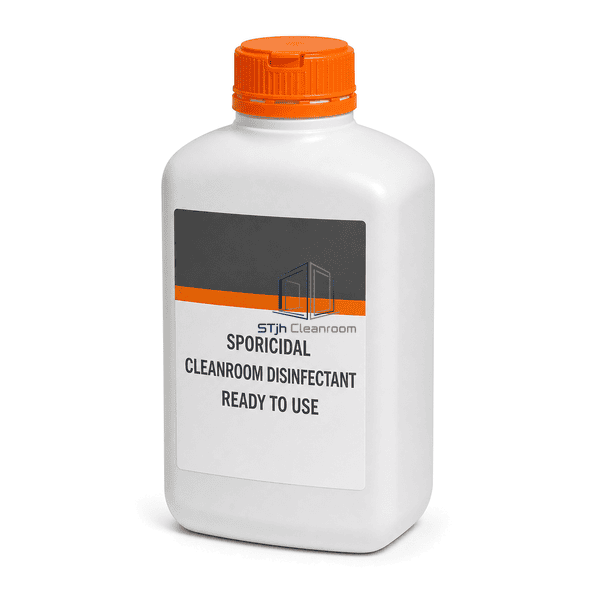
Sporicidal Disinfectant is a clear, colorless ready-to-use aqueous blend of hydrogen peroxide and peracetic acid for hard, nonporous cleanroom surfaces. The compact 0.95 L opaque white HDPE bottle limits light exposure and is easy to control during wipe saturation or local dispensing. Its centered threaded neck uses a ribbed orange tamper-evident closure with an integrated low-profile flip cap, allowing the primary bottle to remain closed between applications without a trigger mechanism. The premixed solution suits scheduled rotational treatment of work surfaces, equipment exteriors, pass-through interiors, floors, walls, and other compatible areas after soil has been removed. Sterile-processed and protected-bag presentations may be selected for higher-control transfer routes, while larger capped containers support mop systems and repeated large-area cycles.
Características clave
Broad oxidizing mechanism suitable for a scheduled sporicidal stage
Premixed concentration avoids manual dilution errors
Clear, water-soluble and nonflammable liquid
Wetting-agent and corrosion-inhibitor formulation options
Compact opaque HDPE bottle without a trigger or carry handle
Closed dispensing flip cap with tamper-evident ring
Sterile-processed and protected-bag cleanroom formats available
Preocupaciones del producto del cliente
Bacterial spores are more resistant than vegetative cells and can survive a routine disinfectant rotation if sporicidal treatment is omitted or shortened. Oxidizing sporicides also require more disciplined use than alcohol: organic soil consumes active chemistry, incomplete wetting leaves untreated areas, and acidic peroxide blends can affect unsuitable metals, elastomers, coatings, or electronics. A defined pre-cleaning step, verified substrate compatibility, controlled liquid delivery, complete surface wetting, adequate ventilation, and a documented rinse or residue-removal stage where needed make the sporicidal cycle repeatable without unnecessary chemical loading.
Can organic residue prevent the sporicide from reaching the surface?Visible soil and process residue should be removed with a compatible detergent before application. A defined pre-cleaning and rinse sequence leaves the oxidizing chemistry available for the sporicidal step instead of consuming it on residual soil.
How is complete wet-contact time maintained on vertical or large surfaces?A qualified low-lint wipe or mop and a fixed dispensing volume provide an even liquid film without uncontrolled flooding. Operators can work in mapped sections, rewet dry areas, and start the contact interval only after the entire target section is visibly wet.
Will an acidic peroxide blend damage cleanroom materials?Compatibility should be established on the actual stainless steel, aluminum, coating, plastic, elastomer, sealant, and electronic enclosure before routine use. A formulation containing suitable wetting agents and corrosion inhibitors, followed by the specified rinse where required, reduces unnecessary exposure while preserving coverage.
How are mixing and concentration errors avoided?The ready-to-use bottle arrives at its working concentration and needs no activator or point-of-use dilution. A tamper-evident closed flip cap supports direct dosing to the applicator while limiting open handling of the primary package.
What controls odor, residue, and operator exposure during a sporicidal cycle?Use the smallest qualified application volume that still maintains full wetting, provide the ventilation and personal protective equipment stated in the applicable safety information, and remove remaining film with the approved high-grade water rinse when the process requires it. Keeping the bottle closed between doses also limits unnecessary vapor release.
Aplicaciones típicas
Scheduled sporicidal treatment in pharmaceutical cleanroomsDecontamination of compatible workbenches and preparation surfacesWipe-down of pass-through interiors and material-transfer equipmentTreatment of stainless-steel carts and noncritical equipment exteriorsMop application to compatible floors, walls, and ceilingsBiotechnology and cell-processing support roomsMedical-device production and controlled packaging areasResearch, laboratory, cosmetics, and nutritional manufacturing facilities
Parámetros técnicos
Hydrogen peroxide and peracetic acid create a broad oxidizing system that damages microbial membranes, proteins, enzymes, and other essential cell components. Representative ready-to-use cleanroom formulations combine approximately 4.4% hydrogen peroxide with 0.23% peracetic acid and include wetting agents or corrosion inhibitors to improve surface coverage and material compatibility. The clear acidic liquid is supplied premixed, so its effective strength is not altered by operator measurement or local dilution water. Sporicidal performance remains formulation- and label-specific; the named organism, surface condition, application volume, temperature, and full wet-contact time must therefore follow the selected product directions.
| Materiales Core | Ready-to-use aqueous blend with approximately 4.4% hydrogen peroxide and 0.23% peracetic acid |
|---|---|
| Panel de espesor | 0.8–1.4 mm nominal wall thickness for the compact opaque HDPE bottle |
| Ancho efectivo | 105–125 mm typical body width for a 0.95 L rounded-rectangle bottle |
| Longitud máxima | 225–260 mm typical overall height including the closed dispensing cap |
| Acero frente a espesor | 0 mm; polymer primary packaging without steel facing |
| Densidad Core | Approximately 1010–1020 kg/m³ at 15–20 °C |
| Conductividad térmica | Approximately 0.56–0.60 W/(m·K) at 20 °C for the aqueous formulation |
| Superficie acabada | Clear, colorless liquid in a smooth opaque white HDPE primary bottle |
| Tipo conjunto | Threaded neck with a ribbed tamper-evident closure and integrated sealed flip cap |
| Customization | Disponible según la aplicación prevista y el entorno operativo. |
Opciones disponibles
0.9–0.95 L opaque dispensing bottle3.78–5 L capped container for mop saturationHydrogen peroxide and peracetic acid ready-to-use formulationAlternative stabilized active-chlorine sporicidal chemistryIntegrated flip cap or closed transfer connectorSterile-processed or controlled-environment-filled presentationSingle-, double-, or triple-bagged transfer packageCorrosion-inhibitor and low-residue formulation options
Planning a Sporicidal Disinfectant specification?
Envíenos sus dimensiones, condiciones de instalación, objetivos de rendimiento y acabado superficial requerido.