
 ภาษาอังกฤษ
 ภาษาเยอรมัน
 ภาษาอาหรับ
 ฝรั่งเศส
 ภาษาอินโดนีเซีย
 ภาษาญี่ปุ่น
 ภาษาเกาหลี
 ภาษามาเลย์
 ภาษาโปรตุเกส
 ภาษารัสเซีย
 ภาษาสเปน
 ภาษาไทยปัจจุบัน
 ภาษาตุรกี
 ภาษาเวียดนาม

ระบบสาธารณูปโภคห้องสะอาด
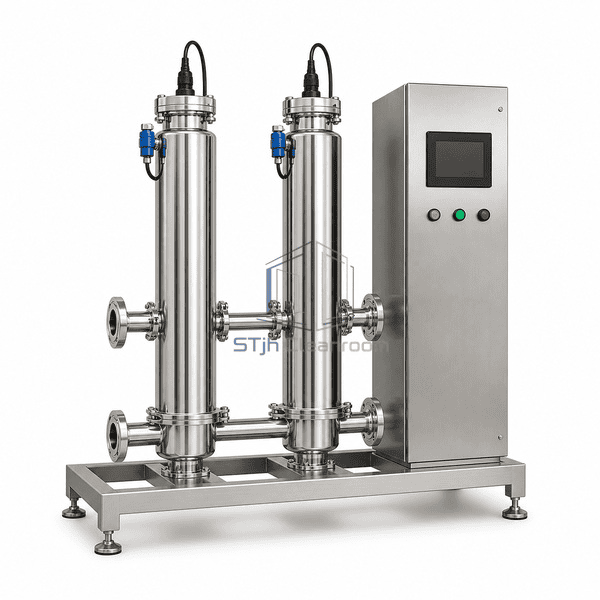
หน่วยลด TOC UV
A monitored 185 nm ultraviolet oxidation unit that converts trace organic contaminants into more readily removable ionic and gaseous species.
- 185 nm organic oxidation
- Dual hygienic UV reactors
- Monitored high-purity operation
การแนะนําสินค้า
The TOC reduction UV unit exposes high-purity water to short-wave ultraviolet energy that forms reactive hydroxyl species. These oxidize trace organic molecules into smaller compounds, carbon dioxide and ionic fragments that downstream polishing equipment can remove more effectively. Twin reactors provide practical lamp power and service flexibility in a compact skid.
คุณสมบัติที่สําคัญ
Twin 316L reactor arrangement
High-purity quartz sleeves
UV intensity and lamp-hour monitoring
Sanitary stainless manifolds
Separate protected controller
Configurable series or parallel flow
Integration with ion exchange or degassing
ความกังวลของลูกค้าเกี่ยวกับผลิตภัณฑ์
TOC oxidation performance depends on UV transmittance, lamp output, residence time and the ability of downstream treatment to remove oxidation products.
Trace organics pass conventional deionizationApply 185 nm UV upstream of polishing resin to convert weakly ionized organics into removable products.
Lamp output drifts unnoticedTrack UV intensity and operating hours independently for each reactor.
Oxidation products accumulate in the loopCoordinate the UV duty with downstream ion exchange and membrane-degassing capacity.
Quartz fouling reduces photon transferMaintain feed-water quality and schedule sleeve inspection and cleaning.
การใช้งานทั่วไป
Pharmaceutical purified-water polishingUltrapure laboratory waterSemiconductor rinse-water productionBiotechnology process-water loopsFeed polishing before high-purity points of use
พารามิเตอร์ทางเทคนิค
Lamp count, reactor configuration and power are selected from flow, inlet TOC, UV transmittance and downstream polishing capacity.
| วัสดุหลัก | 316L stainless steel reactors with high-purity fused-quartz lamp sleeves |
|---|---|
| ความหนาของแผง | Reactor wall typically 2.0–5.0 mm |
| ความกว้างที่มีประสิทธิภาพ | Skid width typically 600–1400 mm |
| ความยาวสูงสุด | Complete skid height or length typically up to 2400 mm |
| ความหนาของเหล็กหันหน้า | Control enclosure and skid sheet components typically 1.5–3.0 mm |
| ความหนาแน่นหลัก | 316L stainless steel density approximately 8000 kg/m³ |
| การนําความร้อน | 316L stainless steel approximately 15 W/(m·K) at ambient temperature |
| เสร็จสิ้นพื้นผิว | Electropolished or mechanically polished wetted reactors with satin-finished skid and enclosure |
| ประเภทร่วม | Orbital-welded or sanitary-clamp manifolds with sealed quartz sleeves and instrument ports |
| การปรับแต่ง | สามารถใช้ได้ตามแอปพลิเคชันที่ตั้งใจไว้และสภาพแวดล้อมการทํางาน |
ตัวเลือกที่มีอยู่
Single or twin reactorsSeries or parallel pipingUV intensity sensorFlow interlockTOC analyzer interfaceRemote communicationStainless control enclosure
Planning a TOC Reduction UV Unit specification?
ส่งมิติของคุณเงื่อนไขการติดตั้งเป้าหมายประสิทธิภาพและผิวที่ต้องการ