
 Englisch
 DeutschCurrent
 Arabisch
 Französisch
 indonesisch
 Japanisch
 Koreanisch
 Malaiisch
 Portugiesisch
 Russisch
 Spanisch
 Thailändisch
 Türkischer Sprache
 Vietnamesisch

Cleanroom Utility Systemen
VOC Abgasbehandlungseinheit
Compact skid-mounted flameless regenerative thermal oxidation unit that treats compatible low- to medium-concentration VOC exhaust through an insulated ceramic heat-exchange bed with controlled electric or gas support energy.
- Flameless oxidation within a regenerative ceramic bed
- Compact modular skid with integrated fan and PLC controls
- High internal heat recovery reduces support-energy demand
Produkteinführung
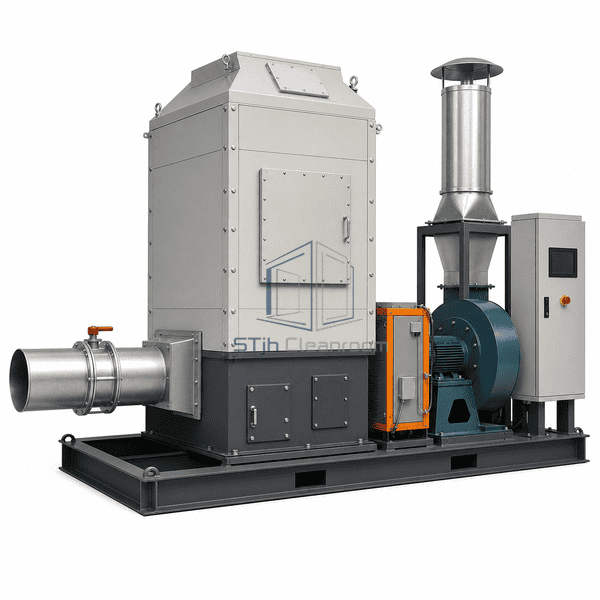
The VOC Exhaust Treatment Unit is a compact regenerative thermal oxidizer for compatible organic-vapor exhaust from coating, printing, electronics, pharmaceutical and clean-manufacturing processes. Contaminated air is drawn through a regenerative media bed, heated to the selected oxidation condition and held long enough for the organic load to be converted primarily to carbon dioxide and water. Alternating flow through the media recovers much of the sensible heat before clean exhaust leaves the unit. The displayed configuration combines one insulated oxidation module, one process fan, one inlet isolation damper, one electric support-heater section, one PLC cabinet and a common base. Exhaust composition, concentration, particulate loading, halogens, oxygen content, flow turndown and heat recovery are evaluated before selecting the treatment arrangement.
Key Features
Flameless operation avoids a conventional open burner inside the oxidation zone
Ceramic media stores and returns process heat as the airflow direction alternates
A dedicated process fan maintains the required exhaust movement through the treatment train
PLC sequencing coordinates warm-up, damper movement, operating temperature and controlled shutdown
Differential-pressure and temperature points provide practical indication of bed loading and thermal condition
An inlet isolation damper separates the process duct during maintenance or a defined trip
Modular casing and removable service panels provide access to the fan, heater, valves and media sections
Electric or compatible fuel support energy can be selected for the available site utility
Secondary heat-recovery connections can be evaluated when useful recovered energy has a stable destination
Kunden Produktbedenken
VOC abatement performance depends on the real exhaust chemistry and operating envelope. Concentration, oxygen, particulates, corrosive species, flow variation and heat release must be understood before an oxidation system is selected.
Large swings in VOC concentration can move the oxidizer between support-energy demand and excessive heat releaseCharacterize normal, startup and upset loading, then apply suitable dilution, bypass, heat-removal and control limits for the selected stream.
Particulate, condensable aerosol or resin can foul the ceramic bed and raise pressure dropProvide compatible upstream separation and keep the duct and treatment train above problematic condensation conditions where required.
Halogenated, sulfur-bearing or silicon-containing compounds can create corrosive products or persistent depositsReview every expected constituent and add compatible metallurgy, downstream neutralization or another treatment technology when oxidation alone is unsuitable.
A process may be sensitive to pressure changes when the flow direction switchesSize the fan, switching valve and control sequence around the permitted process pressure fluctuation and verify it through the full operating range.
Insufficient warm-up or an uncontrolled shutdown can leave untreated exhaust or damage internal componentsInterlock process admission with verified thermal conditions and use a defined purge, cooldown and emergency-isolation sequence.
A nominal destruction figure may not represent the installed exhaust mixture or required legal test basisDefine the target compounds, operating envelope, sampling locations and acceptance method before selecting and evaluating the final system.
Typische Anwendungen
Semiconductor, display and electronics process exhaust containing compatible organic vaporsPharmaceutical coating, solvent-handling and formulation exhaustPrinting, laminating and surface-coating lines with dilute VOC streamsBattery, composite and advanced-material manufacturing exhaustOdor-bearing industrial air streams where thermal oxidation is technically suitableCentral treatment of several balanced low- to medium-concentration VOC sources
Technische Parameter
The displayed basis is one compact skid-mounted flameless regenerative thermal oxidation module with an insulated carbon-steel casing, a 96 kg/m³ high-temperature fiber lining, ceramic heat-exchange media, one direct-coupled process fan, one electric support-heater section and one side-mounted PLC cabinet. The site's fixed ten-row table uses panel-oriented labels; here the dimensional rows describe the displayed insulated module rather than a universal oxidizer size. Final airflow, residence condition, heat release, utility load, metallurgy, switching arrangement and pressure control remain application-selected.
| Core Material | Insulated carbon-steel process casing with regenerative ceramic media, 96 kg/m³ high-temperature fiber lining, stainless hot-face retainers and separate fan and control modules |
|---|---|
| Panel Dicke | 50-100 mm representative high-temperature lining build-up for the displayed modular casing |
| Effektive Breite | Approximately 2200 mm displayed skid width including oxidation module, fan and side control cabinet |
| Maximale Länge | Approximately 4500 mm displayed skid length including inlet section and maintenance clearance envelope |
| Stahl facing Dicke | 3-6 mm representative welded carbon-steel outer casing, with hot-zone reinforcement selected for temperature and pressure |
| Kerndichte | 96 kg/m³ representative density for the selected high-temperature fiber insulation layer |
| Thermische Leitfähigkeit | Approximately 0.12 W/(m·K) at a 538°C mean temperature for a representative 128 kg/m³ ceramic-fiber blanket; final lining grade is selected separately |
| Oberfläche Finish | Light-gray industrial coating on cool external steel, dark stainless hot-zone trim, natural-silver ductwork and restrained safety-color handles and indicators |
| Gemeinsamer Typ | Welded and bolted insulated module joints with flanged process-duct connections, gasketed service doors and wired PLC and instrument interfaces |
| Customisierung | Verfügbar je nach beabsichtigter Anwendung und Betriebsumgebung. |
Verfügbare Optionen
Single, twin or multiple modular treatment trains for the required exhaust flowElectric, natural-gas or other compatible support-energy arrangementsAlternative ceramic-media geometries for pressure-drop and thermal-recovery targetsUpstream particulate, aerosol or condensate pretreatmentCorrosion-resistant hot-face alloys for compatible challenging exhaust chemistryProcess bypass, dilution-air and high-temperature heat-removal configurationsSecondary heat recovery to air, water, thermal oil or steam serviceRemote HMI, historian and plant-network communication interfacesDifferential-pressure, LEL, oxygen and expanded temperature monitoringIndoor or weather-protected outdoor modular enclosure packages
Planning a VOC Exhaust Treatment Unit specification?
Senden Sie uns Ihre Abmessungen, Installationsbedingungen, Leistungsziele und gewünschte Oberflächenveredelung.