
 Englisch
 DeutschCurrent
 Arabisch
 Französisch
 indonesisch
 Japanisch
 Koreanisch
 Malaiisch
 Portugiesisch
 Russisch
 Spanisch
 Thailändisch
 Türkischer Sprache
 Vietnamesisch

Reinraumbekleidung, PPE und Verbrauchsmaterialien
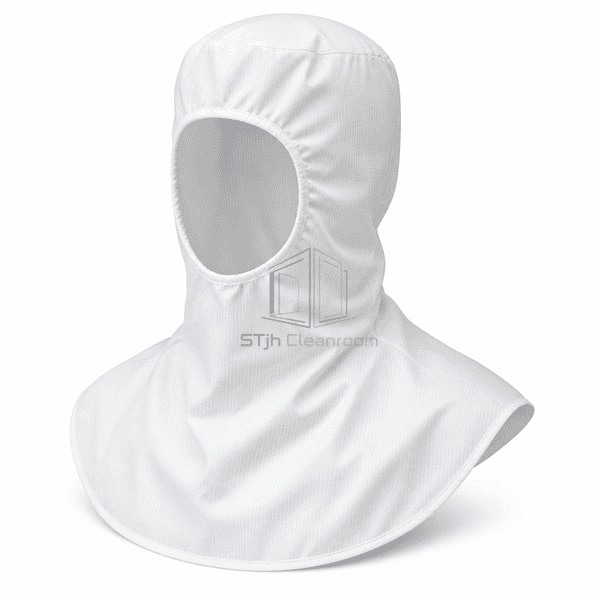
Reinraum Balaclava Hood
A low-lint balaclava-style cleanroom hood with an elasticated face aperture and extended cape for secure gown overlap.
- Elasticated oval face opening
- Cape-style shoulder and neck coverage
- Low-lint bound-seam construction
Produkteinführung
The Cleanroom Balaclava Hood combines close head coverage with a flexible oval facial opening and an extended cape around the neck and shoulders. Unlike an eyes-only hood, its elasticated aperture is designed to frame the face while remaining compatible with a separately selected mask and eye protection. Bound seams and a smooth low-lint shell help manage garment-edge exposure in controlled cleaning and preparation work.
Key Features
Cape-style bib extends across the shoulders for garment overlap
Bound crown and cape seams cover raw material edges
Lightweight white material provides visible contrast for cleanliness checks
One-size geometry supports straightforward stock control
Kunden Produktbedenken
Balaclava hoods must retain their position when the wearer turns the head, while leaving enough space for approved masks and eyewear. An unstable aperture or short cape can compromise gown overlap.
The facial aperture may widen or migrate during movement.Use a softly elasticated oval opening with consistent edge recovery.
Separate mask straps can interfere with the hood edge.Confirm mask and eyewear compatibility during gowning-system selection.
The cape may bunch or pull free at the garment neckline.Specify an extended cape with balanced front, side and rear overlap.
Exposed seam edges may shed near the controlled task.Select bound seam construction and clean packaging suited to the work zone.
Typische Anwendungen
Suitable for cleanroom cleaning and preparation, pharmaceutical support areas, controlled laboratories, medical-device processing and other gowning programs that use separate face masks and eye protection.
Technische Parameter
These configurable values describe a separate balaclava-style cape hood. Final aperture dimensions and material must be matched to the complete facial PPE and outer garment system.
| Core Material | Microporous polyethylene film laminated to nonwoven polypropylene |
|---|---|
| Panel Dicke | 0.16–0.28 mm |
| Effektive Breite | 500–620 mm when laid flat |
| Maximale Länge | 520 mm |
| Stahl facing Dicke | 0 mm; no steel facing used |
| Kerndichte | 65–105 kg/m³ apparent material bulk density |
| Thermische Leitfähigkeit | 0.035–0.060 W/(m·K), material dependent |
| Oberfläche Finish | Smooth low-lint white outer surface with elasticated facial edge |
| Gemeinsamer Typ | Bound crown and cape seams with enclosed elastic face opening |
| Customisierung | Verfügbar je nach beabsichtigter Anwendung und Betriebsumgebung. |
Verfügbare Optionen
Microporous laminate or flash-spun polyethylene shellElasticated open-face or fixed bound apertureStandard or extended cape lengthSterile or non-sterile configurationClean-processed individual packagingWhite or application-specific light color
Planning a Cleanroom Balaclava Hood specification?
Senden Sie uns Ihre Abmessungen, Installationsbedingungen, Leistungsziele und gewünschte Oberflächenveredelung.