
 Englisch
 DeutschCurrent
 Arabisch
 Französisch
 indonesisch
 Japanisch
 Koreanisch
 Malaiisch
 Portugiesisch
 Russisch
 Spanisch
 Thailändisch
 Türkischer Sprache
 Vietnamesisch

Cleanroom Utility Systemen
Lokale Auspuff-Hood
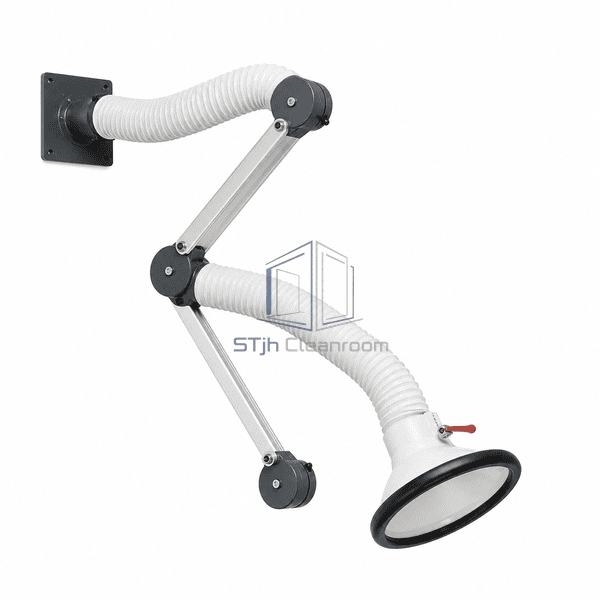
Wall-mounted positionable local exhaust hood with a 160 mm corrosion-resistant articulated arm, external anodized supports, 360-degree swivel and integrated damper for source capture of compatible fumes and vapors.
- Capture hood positions close to the emission source
- Articulated arm rotates and holds its working position
- Corrosion-protected components suit compatible chemical areas
Produkteinführung
The Local Exhaust Hood is a positionable capture device for removing compatible fumes, vapors and light non-combustible airborne contaminants near the point of release. A wall-mounted swivel connects to a 160 mm flexible white hose supported by two external anodized-aluminum arm sections and three friction joints. The circular bell hood can be tilted around the source, while an integral damper provides local airflow adjustment. The displayed 3 m arm is intended to connect to a separately sized exhaust fan, duct and treatment system. Effective capture depends on hood distance, source momentum, cross-drafts, arm pressure loss and the airflow available at the connection.
Key Features
A 360-degree wall swivel lets the arm serve a broad area around one mounting point
Two articulated support sections and friction joints hold the selected position without a floor stand
External anodized-aluminum supports remain outside the extracted air path and receive added corrosion protection
The smooth 160 mm flexible hose bends with the arm while maintaining a defined circular flow path
A tilting bell hood can be aimed toward rising vapor, light fume or a localized release
An integrated damper allows local balancing without adding a separate loose valve at the hood
The wall bracket provides a clear round connection to fixed exhaust ductwork
Several arm lengths allow reach to be matched to the bench, vessel or equipment position
Hood light and fan-switch accessories can be added without changing the basic source-capture function
Kunden Produktbedenken
Local exhaust succeeds only when the hood stays close enough to the source and the connected system supplies adequate airflow. Position, cross-drafts and contaminant behavior can matter more than the nominal duct diameter.
Capture falls rapidly when the hood is moved too far from the releasePosition the hood as close as the task allows and arrange the work so the contaminant moves toward, not past, the opening.
Room supply jets, doors or operator motion can deflect fumes away from the hoodReduce cross-drafts at the workstation and place the hood on the downstream side of predictable contaminant movement.
A long or sharply bent arm can add enough pressure loss to reduce the intended airflowInclude the selected arm position, flexible hose, duct and damper in the fan and system-resistance calculation.
Friction joints can drift if the arm is overloaded or not adjusted for the hood weightMount the bracket on a suitable structure, balance the joints and keep unsupported accessories within the arm's intended configuration.
Condensable or aggressive vapor can attack the hose, hood, seals or downstream ductConfirm the complete material path for the expected chemical and temperature, and use a different capture product where compatibility is uncertain.
A local hood can spread contamination if it is used for combustible dust or hot material outside its design boundarySeparate combustible, high-temperature and reactive hazards and choose a capture system specifically rated for that service.
Typische Anwendungen
Localized chemical weighing, transfer and bench-top preparationPharmaceutical and clean-manufacturing workstations with intermittent compatible vapor releaseLaboratory soldering, bonding and solvent-cleaning tasksBattery, electronics and materials-development benchesFood and chemical production sampling points requiring a positionable hoodMaintenance activities where a fixed enclosure cannot reach the emission source
Technische Parameter
The displayed basis is one indoor 3 m corrosion-resistant extraction arm with a 160 mm smooth flexible hose, two anodized-aluminum external support sections, three adjustable joints, one 360-degree wall swivel and one tilting circular hood with an integral damper. The manufacturer's published arm family uses 700-1000 m³/h recommended airflow and a maximum 70°C fume temperature for the referenced design. The fixed ten-row table uses panel labels; its dimensional rows describe hose diameter, hood span and reach rather than wall-panel dimensions.
| Core Material | White corrosion-resistant flexible hose and molded capture hood with external anodized-aluminum support arms, polymer friction joints and a corrosion-protected wall swivel and bracket |
|---|---|
| Panel Dicke | 160 mm nominal flexible-hose diameter for the selected extraction-arm basis |
| Effektive Breite | Approximately 330 mm displayed bell-hood capture diameter, excluding the damper handle |
| Maximale Länge | 3000 mm nominal arm reach for the selected model; 2000 mm and 4000 mm arrangements are also available |
| Stahl facing Dicke | 0 mm steel facing on the hose or hood; metal support links and wall hardware are separate structural components |
| Kerndichte | Approximately 1440 kg/m³ representative density for a corrosion-resistant rigid PVC material used only as the fixed-row polymer reference |
| Thermische Leitfähigkeit | Approximately 0.20 W/(m·K) for a representative PVC-U material used only as the fixed-row polymer reference |
| Oberfläche Finish | Smooth white chemical-resistant hose and hood, natural-silver anodized support arms, dark-gray joints and a red local damper handle |
| Gemeinsamer Typ | Clamped flexible hose around an external articulated support with adjustable friction pivots, 360-degree wall swivel and tilting dampered hood |
| Customisierung | Verfügbar je nach beabsichtigter Anwendung und Betriebsumgebung. |
Verfügbare Optionen
Nominal arm lengths of 2000, 3000 or 4000 mmVertical-link or horizontal-link arrangements for selected long armsAlternative wall brackets and 1000 or 2000 mm extension bracketsCeiling, rail, fixed-filter or mobile-filter mounting interfacesCorrosion-resistant or standard hose and support constructionsIntegrated hood damper and compatible airflow indicatorHood-mounted task light and remote fan switchAlternative capture hood geometries for the source shapeFlexible connector and fixed duct transition at the wall swivelExhaust fan and treatment package sized for the required capture duty
Planning a Local Exhaust Hood specification?
Senden Sie uns Ihre Abmessungen, Installationsbedingungen, Leistungsziele und gewünschte Oberflächenveredelung.