
 Englisch
 DeutschCurrent
 Arabisch
 Französisch
 indonesisch
 Japanisch
 Koreanisch
 Malaiisch
 Portugiesisch
 Russisch
 Spanisch
 Thailändisch
 Türkischer Sprache
 Vietnamesisch

Reinraum-Test - und Validierungsinstrumente
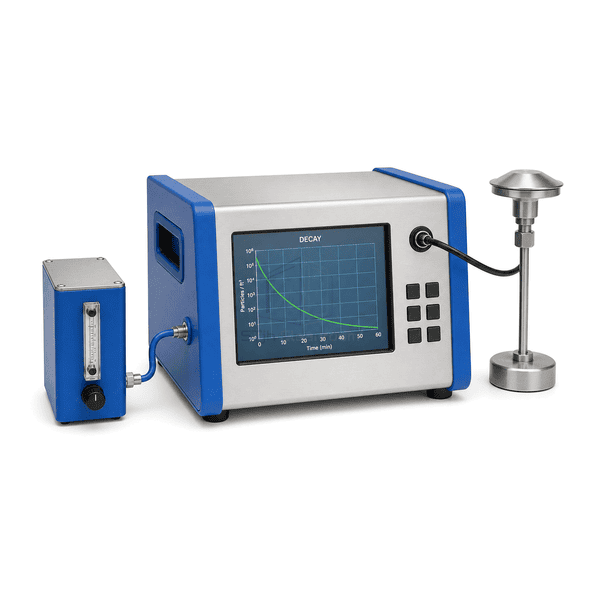
Cleanroom Recovery Test System
A portable cleanroom recovery test system that pairs continuous airborne-particle sampling with a separately controlled challenge-aerosol module to record concentration decay against a defined test plan.
- Timed particle-decay recording.
- Separated sampling and challenge paths.
- Controlled portable recovery testing.
Produkteinführung
This coordinated field system combines a portable light-scattering particle measurement unit, one stainless isokinetic sample head and a separate compact aerosol challenge module. After the room baseline and target concentration are defined, the challenge module is used to raise the selected particle population under controlled conditions; challenge output is then stopped and the main instrument records successive particle concentrations versus time. The screen presents the decay trend for evaluation as a direct recovery interval or recovery-rate segment. Applicability, occupancy state, challenge material, target level, sampling position and acceptance criteria remain controlled by the approved procedure, so the system records evidence but does not automatically certify the cleanroom.
Key Features
Dedicated isokinetic sample head and one short low-loss tube maintain a clearly defined sampling path to the particle measurement unit.
Separate challenge module provides controlled aerosol output without combining the generator reservoir with the particle-sensing path.
One visible flowmeter and one fine adjustment knob make challenge output condition observable before the decay recording begins.
Six-key local interface supports baseline capture, timed sequence setup, start/stop, marker placement and result review without multiple display panels.
Portable silver-gray and blue enclosure, side handles and stable feet support temporary installation at a planned room location.
Kunden Produktbedenken
Recovery testing must raise particle concentration enough to produce a usable decay while avoiding counter overload, unsuitable aerosol exposure and residue; repeatable sample position, timing, flow and target selection are essential to interpretable results.
An excessive aerosol challenge can leave residue or overload the particle counter instead of producing useful recovery data.Establish the room baseline and target first, select the lowest practical challenge concentration, verify the counter range and use dilution or a lower generator setting when required.
Challenge aerosol may not be appropriate for the room materials, process or occupancy state.Select an approved aerosol and test state through the site risk assessment, review compatibility and cleaning requirements, and do not challenge an operating process without authorization.
Sampling-tube losses or a poorly positioned head can distort the measured decay curve.Use the designated isokinetic head, keep the black sample tube short and smooth, secure the planned location and avoid bends or surfaces that can alter particle transport.
A change in sample interval or flow during the test can make successive concentration points incomparable.Configure the same sample volume, interval and flow for baseline, challenge confirmation and decay recording, then confirm stable instrument operation before starting the timer.
A displayed recovery time may be treated as an automatic pass result without reviewing the test plan.Export the time-stamped readings and evaluate the selected direct-recovery or recovery-rate method against the approved target, room state and acceptance criteria.
The challenge source can remain active while decay timing has already begun.Use a documented start-stop sequence, visibly confirm generator output is off, mark the transition point and begin decay analysis only from the defined challenge-stop event.
Typische Anwendungen
Non-unidirectional cleanroom recovery-time studiesAs-built and at-rest ventilation performance investigationsControlled-environment commissioning and requalification supportRecovery-rate comparison before and after HVAC adjustmentDeviation investigation following elevated airborne-particle events
Technische Parameter
The representative system below combines particle sampling, time-series recording and a separately regulated aerosol challenge source. Final particle-size channels, counter flow, challenge medium, concentration range, sampling interval and evaluation method should be selected for the approved recovery-test procedure.
| Core Material | Anodized-aluminum main chassis with PC/ABS blue protective rails, 316L stainless isokinetic sampling head, conductive low-loss sampling tube, powder-coated challenge-module enclosure and compatible aerosol tubing |
|---|---|
| Panel Dicke | Typically 2.0-3.0 mm for the main enclosure panels and protective rail sections |
| Effektive Breite | Approximately 420-520 mm across the portable main unit, excluding the separate challenge module |
| Maximale Länge | Approximately 520-680 mm for the complete arranged system including the challenge module and connected tubing |
| Stahl facing Dicke | Typically 0.8-1.5 mm for stainless sampling supports, probe guards and interface brackets |
| Kerndichte | Approximately 2700 kg/m³ for the anodized-aluminum main chassis sections |
| Thermische Leitfähigkeit | Approximately 160-205 W/(m·K) for the aluminum chassis alloy |
| Oberfläche Finish | Satin silver-gray main enclosure, cobalt-blue protective rails and handles, blue-white color display, charcoal keys, black sampling tube, satin stainless sample head and cobalt-blue challenge module with clear flow tube |
| Gemeinsamer Typ | Single low-loss sample inlet with detachable black tube and isokinetic head, plus one separate blue challenge line between the compact generator module and the designated system interface |
| Customisierung | Verfügbar je nach beabsichtigter Anwendung und Betriebsumgebung. |
Verfügbare Optionen
Portable particle-counter configurations with selectable flow and size channelsAlternative stainless isokinetic heads and sampling standsLow-loss conductive or transparent sample-tube setsAdjustable-output droplet or salt-solution challenge module configurationsAerosol dilution interface for high challenge concentrationsRechargeable battery package and field transport caseUSB or Ethernet result export and configurable decay-analysis templates
Planning a Cleanroom Recovery Test System specification?
Senden Sie uns Ihre Abmessungen, Installationsbedingungen, Leistungsziele und gewünschte Oberflächenveredelung.