
 Englisch
 DeutschCurrent
 Arabisch
 Französisch
 indonesisch
 Japanisch
 Koreanisch
 Malaiisch
 Portugiesisch
 Russisch
 Spanisch
 Thailändisch
 Türkischer Sprache
 Vietnamesisch

Reinraumbekleidung, PPE und Verbrauchsmaterialien
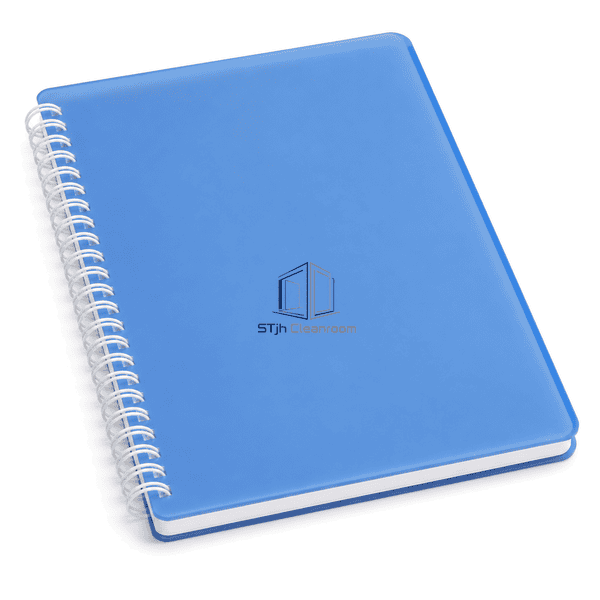
Cleanroom Notebook
Spiral-bound cleanroom notebook with 50 low-particle lined sheets, translucent polymer covers and controlled low-sodium printing.
- Low-particle cleanroom paper with controlled ruling
- Durable translucent polypropylene covers
- Plastic spiral binding opens flat for gloved use
Produkteinführung
The Cleanroom Notebook packages controlled documentation paper in a durable lay-flat format for repeated production use. Polymer-bound sheets reduce loose fiber generation, while a plastic spiral permits full page rotation without a metal binding. Translucent chemical-resistant covers protect records during handling and rounded corners reduce snagging on gloves.
Key Features
Plastic spiral avoids exposed metal and allows flat opening
Low-sodium, solvent-resistant ruling supports clean documentation
Translucent PP or HDPE covers resist routine handling chemicals
A4, A5 and letter formats serve different workstations
Kunden Produktbedenken
A cleanroom notebook must combine particle-controlled paper, stable printing and glove-friendly handling. Standard notebooks can shed from paper, cardboard covers, metal spirals and cut edges.
Binding motion may release debris during frequent page turns.Use a smooth polymer spiral and bound-fiber cleanroom sheets.
Printed lines may smear after contact with cleaning alcohol.Specify low-sodium ruling formulated for resistance to routine IPA contact.
Sharp cover corners can snag thin gloves.Select precision-cut rounded polymer covers.
Cardboard covers absorb spills and introduce fibers.Use translucent polypropylene or polyethylene covers with chemical resistance.
Typische Anwendungen
Used for equipment logs, batch notes, calibration records, laboratory observations, maintenance entries, sampling data and technician notes in cleanrooms and controlled manufacturing areas.
Technische Parameter
The ranges below describe common spiral cleanroom notebooks. Final sheet stock, format, ruling, cover polymer, printing and packaging should match the documentation procedure.
| Core Material | Polymer-bound cellulose cleanroom paper with polypropylene covers |
|---|---|
| Panel Dicke | 6-12 mm closed notebook thickness |
| Effektive Breite | 148-216 mm |
| Maximale Länge | 297 mm |
| Stahl facing Dicke | 0 mm; polymer spiral with no steel binding |
| Kerndichte | 700-950 kg/m³ finished cleanroom paper |
| Thermische Leitfähigkeit | 0.05-0.12 W/(m·K), sheet stack dependent |
| Oberfläche Finish | Translucent blue PP cover with white or blue low-particle ruled pages |
| Gemeinsamer Typ | Side-mounted plastic spiral binding with fully rotating pages |
| Customisierung | Verfügbar je nach beabsichtigter Anwendung und Betriebsumgebung. |
Verfügbare Optionen
A4, A5, letter or memo sizeLined, grid or blank pagesWhite or light-blue sheet stockTranslucent blue, clear or colored cover32- or 50-sheet formatCustom cover and page printing with controlled ink
Planning a Cleanroom Notebook specification?
Senden Sie uns Ihre Abmessungen, Installationsbedingungen, Leistungsziele und gewünschte Oberflächenveredelung.