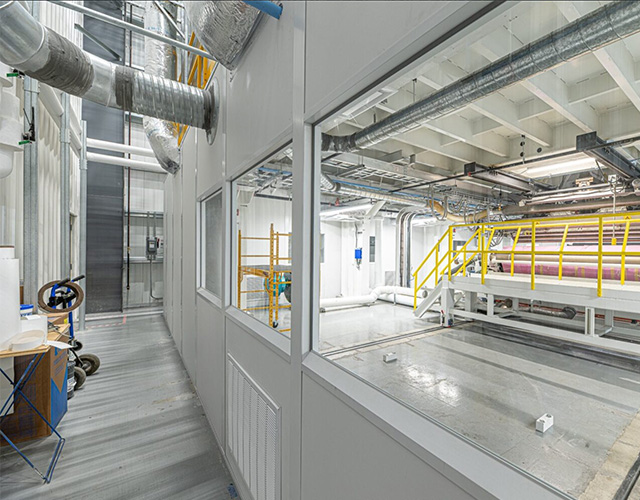
Key Features That Deliver Results
When it comes to a bespoke cleanroom, the final measure isn’t just compliance with specifications but whether the installation is going to pay for itself in productivity, forward momentum, and profit. Some defining features include:
Custom Design: Each room, hallway, and gowning area is mapped so you can avoid bottlenecks in your workflow.
Adaptable Construction Options: Quick, deployable modular cleanrooms or long-term hardwall cleanrooms customized and designed to fit your requirements.
Environmental Uniformity: Precise control of temperature, humidity, and pressure to meet ISO classes.
Material Options: Long-lasting and cleanable FRP, stainless steel, HPL, or static-dissipative laminates.
Air: HEPA or ULPA filters, BIBO containment systems, positive or negative pressurization, and room-side replaceable units.
Special Applications: High-bay housings, mezzanines/catwalks, oversized doors, or custom containment systems.
Every feature directly relates to results: more production, less risk of contamination, and smoother compliance audits.
Applications Across High-Stakes Industries
A custom cleanroom is not a one-size-fits-all asset for all companies. Their design varies widely by industry, ensuring compliance without compromise.
Pharmaceuticals, biotech, aseptic compounding, formulation, and aseptic filling are among the few areas leveraging complete turnkey cleanroom suites. Other industries that depend on custom cleanrooms include:
Medical Devices: Production of implantables or diagnostics in ISO 7–8 zones, including biowaste facilities and gowning areas.
Electronics & Semiconductors: ULPA filtration, static control, and precision air handling protect multi-million-dollar wafers.
Aerospace & Defense: Optics, engines, or satellite parts in manufacturing spaces that require ultra-clean air.
Industrial Manufacturing: Special processes such as coatings, plastics, or composites.
The Future of Modular Cleanrooms
There is, of course, a place for traditional construction—but it can be expensive and slow. Numerous subcontractors extend timelines, add headaches regarding coordination, and increase compliance risks.
On the other hand, modular cleanrooms are constructed in manufacturing plants and only require installation at the construction site. Their benefits include quick deployment, fixed upfront costs, and flexibility to scale or relocate. They also cut downtime, ease capital pressure, and put an end to the mess involved with workforce coordination.
Why Your Cleanroom Manufacturer Matters
More often than not, what separates disaster from success is simply who builds your cleanroom. An established cleanroom supplier offers much more than parts. They offer a solution engineered to perform, meet qualifications, and deliver ROI. With design and production under one roof, the proper partner ensures the quality remains reliable, and that results can be counted on.
Compliant-by-Design and Confidence Baked In
In order to reach compliance for your cleanroom, it has to stand up to more than just a visual inspection. Cleanrooms are required to pass audits from agencies like the FDA, EMA, or ISO certifiers. Designing quality into your custom-built cleanrooms minimizes risks by aligning them with ISO 14644, FDA cGMP, USP 797/800, and EU Annex 1 standards. This results in fewer delays, less rework, and greater peace of mind for both your product and brand.
The Steps That Protect Your Investment
Consulting & Design Review: Establish requirements, SOPs, and objectives.
Design & Modelling: CAD/BIM tools for efficient floorplans and space planning.
Material Selection: Choosing tough, compliant surfaces and systems.
Fabrication & Installation: Parts made under controlled conditions for easy fit-up, with modular systems that install faster and minimize downtime.
The ROI of Custom Cleanrooms
A custom cleanroom is not a cost center; it’s an investment that, in the long run, pays back. It reduces exposure to contamination, increases productivity, and guarantees compliance while protecting revenue and market position. Firms that go with a custom environment experience fewer delays, quicker launches, and greater operational scale.
Instead of, “How much is a cleanroom?”, the better question is, “What does a poorly designed cleanroom cost you in missed opportunities, rework, and exposure?” Add in overseas sourcing delays and compliance headaches, and the case for a U.S.-manufactured cleanroom becomes clear.
Cleanrooms Built for Tomorrow
The market is constantly evolving, regulations are becoming increasingly stringent, and technology continues to advance. Modular, future-proof, and custom-built cleanrooms help you stay one step ahead. As you scale up production, adapt to new processes, or enter new markets, your cleanroom can expand with you.
For businesses reliant on precision manufacturing and regulatory compliance, the choice is clear: procure cleanrooms made in China and customized to your specifications. Otherwise, you gamble with risk, lost time, compliance hurdles, and eroding profits.